Steel Grade Equivalents: Q235, Q355 vs S355, A36 and SS400
Steel grade equivalent chart for buyers: Q235 vs Q355, S235/S355, ASTM A36 and SS400. Compare yield, impact toughness, welding and CE/EN 1090 fit from a CE/ISO factory.
Every export steel project starts with the same procurement question: is the Chinese grade on the mill certificate equivalent to the European, American or Japanese grade on the drawing? Get the answer wrong and the steel either fails inspection at the port, gets rejected by the engineer, or costs more than it should because someone over-specified a grade that the local market cannot supply economically.
This guide is written for buyers, estimators and project engineers who need a practical equivalence map rather than a metallurgy textbook. It compares the structural grades we stock and fabricate every day at our CE and ISO 9001 certified plant in Shangqiu, China: Q235, Q355, and their closest matches in EN, ASTM and JIS standards — and explains what actually changes when you switch from one designation to another.
> Key Takeaways > - Q355B is the current Chinese equivalent to S355JR under GB/T 1591-2018; the older Q345 designation was replaced in 2018 and should not appear on new mill certificates. > - Q235B matches S235JR and SS400 for general structural work, while ASTM A36 sits between S235 and S275 in yield strength and has no mandatory Charpy requirement. > - Equivalence is thickness-sensitive: yield strength drops as sections get thicker, and the two standards diverge above roughly 63 mm. > - Impact toughness, not just yield, decides cold-climate suitability: Q355D / S355J2 handle −20 °C, while Q355B / S355JR are room-temperature grades only. > - For CE-marked steel structures in Europe, material must sit inside an EN 1090-1 factory production control system; grade substitution without supporting test reports can invalidate the declaration of performance.
Why Steel Grade Equivalence Matters in Export Projects
A drawing that calls for S355JR is easy to source in Rotterdam or Dubai. In China, the equivalent stock grade is Q355B. The chemistry, yield and tensile bands overlap closely, but the certificates look different, the impact-test temperatures differ, and the inspection standards are not identical. If the buyer does not state the project standard clearly, a supplier may quote the cheapest grade that technically carries the same name — and that can leave you with steel that is legal to ship but illegal to erect.
The risk shows up in three places:
- Thickness de-rating. A 100 mm thick plate labelled S355 does not deliver 355 MPa yield; EN 10025-2 reduces the guaranteed yield to 295 MPa in that range. Q355 follows a similar ladder but the step points and values are not identical.
- Toughness class. S355JR guarantees 27 J at +20 °C. S355J2 guarantees 27 J at −20 °C. Q355B guarantees 34 J at +20 °C. Swap JR for B on a mild-weather job and you are fine; swap J2 for B on a ski-lift or freezer building and you are not.
- Welding procedure qualification. Equivalent grades can have different carbon-equivalent ceilings and micro-alloying routes. A WPS qualified on S355J2 may need re-qualification if the production steel turns out to be Q355B with a different niobium/vanadium balance.
The Four Major Structural Steel Standards
| Standard | Region | Naming logic | Example grades |
|---|---|---|---|
| GB/T 1591 / GB/T 700 | China | Q = yield point (qu fu dian); number = min yield in MPa at ≤16 mm; letter = impact temperature | Q235B, Q355B, Q355C, Q355D |
| EN 10025-2 | Europe | S = structural steel; number = min yield in MPa; J/R/0/2/K2 = Charpy condition | S235JR, S275JR, S355JR, S355J2, S355K2 |
| ASTM A36 / A572 / A992 | Americas | A = ASTM; 36 = min yield in ksi (×6.895 ≈ MPa); Gr 50 = 50 ksi yield | A36, A572 Gr 50, A992 |
| JIS G3101 / G3106 | Japan | SS = structural steel; 400 = min tensile in MPa; SM = welded structural steel | SS400, SM490B, SM490C |
Q235 vs Q355: Chinese Structural Grades Compared
Q235 and Q355 are the two grades our buyers request most often. Q235 is the workhorse for secondary steel, platforms, bracing and light framing. Q355 is the default for primary frames, crane buildings, long-span portals and any member where weight or deflection matters.
| Property | Q235B (GB/T 700) | Q355B (GB/T 1591-2018) |
|---|---|---|
| Min yield, ≤16 mm | 235 MPa | 355 MPa |
| Min yield, 16–40 mm | 225 MPa | 345 MPa |
| Min yield, >40–63 mm | 215 MPa | 335 MPa |
| Tensile strength | 370–500 MPa | 470–630 MPa |
| Elongation | ≥26 % | ≥21 % |
| Charpy impact | 27 J @ +20 °C | 34 J @ +20 °C |
| Typical carbon max | 0.20 % | 0.24 % |
Q355B is not the only Chinese grade in the family. Q355C and Q355D offer better low-temperature toughness at 0 °C and −20 °C respectively, matching the European S355J0 and S355J2 designations. Q355E extends that to −40 °C for arctic or cryogenic applications.
Steel Grade Equivalents: Comparison Chart
The table below maps the grades most commonly used in cross-border procurement. Treat it as a starting point for negotiation, not as a blind substitution order. Always confirm the governing thickness, impact class and delivery condition on the mill certificate.
| Chinese grade | Closest European | Closest American | Closest Japanese | Yield ≤16 mm | Tensile | Charpy |
|---|---|---|---|---|---|---|
| Q235B | S235JR | — | SS400 | 235 MPa | 370–500 MPa | 27 J @ +20 °C |
| Q235C | S235J0 | — | — | 235 MPa | 370–500 MPa | 27 J @ 0 °C |
| Q235D | S235J2 | — | — | 235 MPa | 370–500 MPa | 27 J @ −20 °C |
| Q355B | S355JR | A572 Gr 50 / A992 | SM490B | 355 MPa | 470–630 MPa | 34 J @ +20 °C |
| Q355C | S355J0 | A572 Gr 50 | SM490C | 355 MPa | 470–630 MPa | 34 J @ 0 °C |
| Q355D | S355J2 | A572 Gr 50 | — | 355 MPa | 470–630 MPa | 34 J @ −20 °C |
| Q355E | S355K2 | — | — | 355 MPa | 470–630 MPa | 27 J @ −40 °C |
What Each Grade Does Best
Q235B / S235JR / SS400
Best for: secondary members, purlins, girts, bracing, handrails, platforms, light framing and temporary structures.These are low-carbon, highly formable grades. They weld with ordinary E50xx or ER70S consumables and rarely need preheat below 25 mm. The trade-off is lower strength, so they are not economical as the main frame of a wide-span warehouse unless the design is extremely light.
Q355B / S355JR / A572 Gr 50
Best for: primary portal frames, crane buildings, long-span beams, truss chords and heavy bracing.This is the global sweet spot for commercial steel buildings. The higher yield lets designers use lighter sections, and the grade is stocked by Chinese mills in all common sections and plate thicknesses. For buyers who want one grade for an entire building, Q355B is usually the answer.
Q355D / S355J2 / A572 Gr 50 (Charpy-qualified)
Best for: cold climates, offshore, bridges, crane runways in sub-zero regions and any structure governed by fatigue.The extra cost comes from tighter chemistry, finer grain practice and guaranteed impact energy at −20 °C. If your project specification says "sub-zero Charpy required," do not accept a room-temperature grade even if the yield number is the same.
ASTM A36
Best for: North American projects where the drawing explicitly calls for A36, or where the engineer has based the design on A36's 250 MPa yield and thicker-section ductility.Because A36 has no mandatory Charpy requirement, it should not be substituted into a European or cold-climate specification without a project-specific waiver.
Welding, CE Marking and EN 1090 Fit
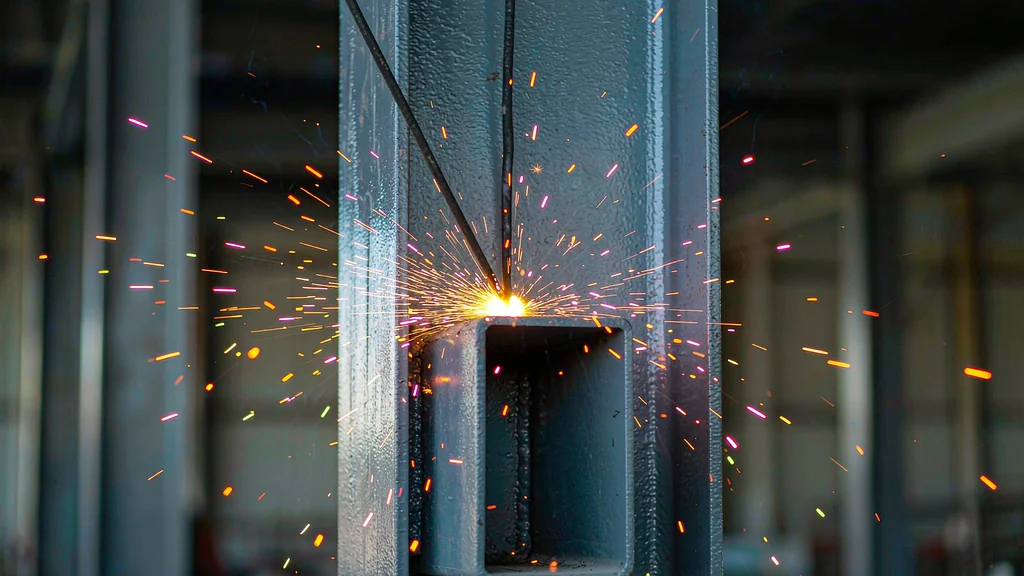
Welding any of these grades is routine in a modern steelworks, but the details matter when the steel is destined for Europe. EN 1090-1 requires a factory production control system and divides structures into execution classes EXC1 to EXC4. The material itself must be covered by a declaration of performance under the Construction Products Regulation, and for structural steel that normally means EN 10025-2 or an accepted equivalent.
If you import Q355B for a CE-marked project, the fabricator must be able to show:
- Mill certificates with the grade, heat number and mechanical test results
- A welding procedure specification qualified on the actual grade and thickness
- Traceability from steel heat to fabricated member
- Inspection records for non-conforming material and corrective actions
Price, Procurement and Delivery Notes
Material cost is only one line in the landed cost of a steel building. In 2026, Q355B typically trades at a US$40–90 per tonne premium over Q235B on the Chinese domestic market, depending on section size, order quantity and coating stage. Add hot-dip galvanizing and the gap narrows because galvanizing cost is driven by surface area and zinc weight, not base steel grade.
For export buyers, the bigger cost driver is often thickness. A project specified with thick plates "because it looks stronger" can push you into a grade where the de-rated yield no longer justifies the weight. A good fabricator will run the design against Q235 and Q355 options and show you the trade-off between material cost and fabrication complexity.
We quote steel structure packages on FOB terms, with typical payment terms of 30 % T/T deposit and the balance before shipment. If you are comparing grades or need a mill certificate template before placing an order, send your drawing or specification to [email protected] or WhatsApp +86 16650735555.
For current price benchmarks, our structural steel price per kg guide breaks down how base steel, processing, surface treatment and shipping contribute to the final tonne cost.
Frequently Asked Questions
Is Q355 the same as S355?
For most room-temperature building applications, Q355B is the closest Chinese equivalent to S355JR. Both have a minimum yield of 355 MPa at ≤16 mm and similar tensile bands. The main difference is impact energy: Q355B guarantees 34 J at +20 °C, while S355JR guarantees 27 J at +20 °C. Always match the toughness letter to the design environment.
What is the difference between Q345 and Q355?
Q345 was the previous Chinese designation under older editions of GB/T 1591. GB/T 1591-2018 replaced Q345 with Q355 and raised the guaranteed minimum yield from 345 MPa to 355 MPa at the first thickness step. New production should be certified as Q355, not Q345.
Can I use Q235B instead of ASTM A36?
It depends on the project. A36 has a 250 MPa minimum yield and no mandatory Charpy requirement. Q235B has a 235 MPa yield and includes a +20 °C Charpy test. Many engineers accept Q235B as an A36 substitute for general fabrication, but it must be approved by the engineer of record because the yield is slightly lower and the testing regime is different.
When should I choose Q355D over Q355B?
Choose Q355D when the design temperature drops below roughly −10 °C, when the specification demands sub-zero Charpy toughness, or when the structure is fatigue-sensitive. The price premium is usually modest compared with the cost of a site rejection.
Does the steel grade affect galvanizing quality?
Yes. Silicon and phosphorus levels influence zinc reactivity and coating thickness. Q235 and Q355 are generally galvanizable, but very high silicon content can cause excessively thick, brittle zinc layers. For aggressive environments, specify the coating class in ISO 1461 or ASTM A123 and review the heat analysis with your galvanizer. Our corrosion protection guide explains how to match steel grade, coating and environment class.
Conclusion
Steel grade equivalence is not about finding an exact twin for every designation; it is about matching strength, toughness, weldability and project acceptance rules to the real supply chain. Q355B will cover most S355JR and A572 Gr 50 needs, Q235B will handle the secondary steel, and Q355D or S355J2 become essential as soon as cold temperatures or fatigue enter the picture.
If you are sourcing a steel structure package from China and need help aligning your drawing grades with mill-available equivalents, send through your bill of materials. We can check grade fit, thickness de-rating and impact class before you commit to a purchase order.
Related Articles
C Purlin vs Z Purlin: Sizes, Spacing, Load & Price 2026
Compare C purlin vs Z purlin: sizes, spacing rules by cladding, load capacity, lapping and coating. Factory-direct cold-formed purlin specs from a CE and ISO 9001 plant.
Steel Structure Engineering: Design to Construction Workflow
Complete guide to steel structure engineering workflow. Learn each phase from design analysis and connection detailing to fabrication, shipping, and on-site
Need a Steel Structure?
Get a free quote from our engineering team. We respond within 2 hours.
Request a QuoteStay Updated
Get steel structure tips, cost guides, and industry insights delivered to your inbox.
No spam. Unsubscribe anytime.