Structural Steel Price Per Kg in 2026: Cost per Tonne Guide
Structural steel costs $0.90-$1.50 per kg fabricated in 2026. See per kg and per tonne prices by product, what is inside the rate, and how to convert it to a budget.
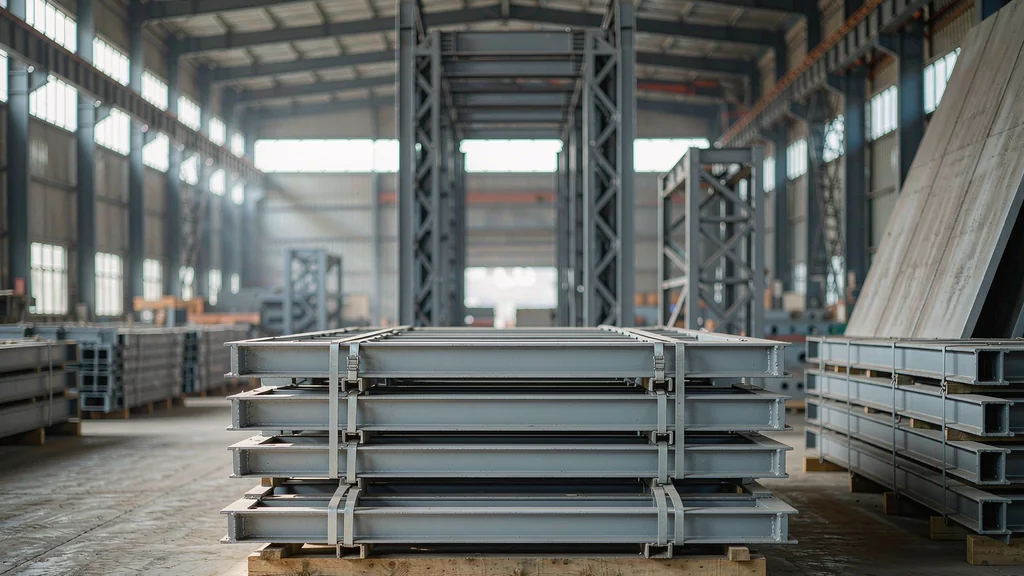
Structural steel in 2026 is priced at roughly $0.90 to $1.50 per kg once it is fabricated, painted and ready to erect — the same thing as $900 to $1,500 per tonne. Raw mill sections alone sit much lower, near $0.55 to $0.75 per kg. Almost every pricing disagreement in this industry comes from quoting one of those numbers and assuming the other.
This guide breaks the per kg rate down element by element, shows how it changes by structure type and finish, and walks through converting a per kg quotation into a full delivered project budget — so you can compare suppliers on equal terms instead of comparing two different scopes.
> Key Takeaways > - Fabricated structural steel runs $0.90–$1.50/kg ($900–$1,500/tonne) in 2026; raw mill material is $0.55–$0.75/kg. > - Raw steel is only 45–55% of a fabricated price per kg. Welding, surface preparation, coating and inspection make up the rest. > - A per kg rate is only comparable when order quantity, coating system, Incoterm and inspection scope are identical — get all four in writing. > - We quote FOB. Freight to the destination port is extra — roughly $0.07–$0.15/kg on a delivered shipment — so never compare an FOB rate with a delivered rate. > - Complexity, not size, drives the ceiling: a space frame or heavy crane frame costs up to 60% more per kg than a simple portal frame.
What Is the Price of Structural Steel Per Kg in 2026?
The price of structural steel per kg depends on how much processing has been done to it. Mill material that has only been rolled and cut to length is cheap. The same steel, cut to drawing, drilled, welded into frames, shot-blasted, painted and inspected, costs substantially more per kilo — because you are buying labour and quality control, not just metal.
These are the ranges we quote from our Shangqiu plant in 2026, a CE and ISO 9001 certified factory running five production lines at 5,000 tonnes per month:
| Steel Product | Price (USD/kg) | Price (USD/tonne) |
|---|---|---|
| Hot-rolled mill sections, unprocessed | $0.55 – $0.75 | $550 – $750 |
| Cut-to-length sections, primed, ex-works | $0.65 – $0.90 | $650 – $900 |
| Fabricated structural steel, FOB China port | $0.90 – $1.20 | $900 – $1,200 |
| Fabricated, painted, CIF to destination port | $1.00 – $1.40 | $1,000 – $1,400 |
| Complex fabrication (space frame, plate girders) | $1.20 – $1.50 | $1,200 – $1,500 |
| Weathering or stainless grades | $2.50 – $4.50 | $2,500 – $4,500 |
For a broader picture of how these unit rates translate into square-metre costs, see our steel structure cost per square meter breakdown, which handles the area-based view of the same numbers.
What Is Actually Inside a Fabricated Price Per Kg?
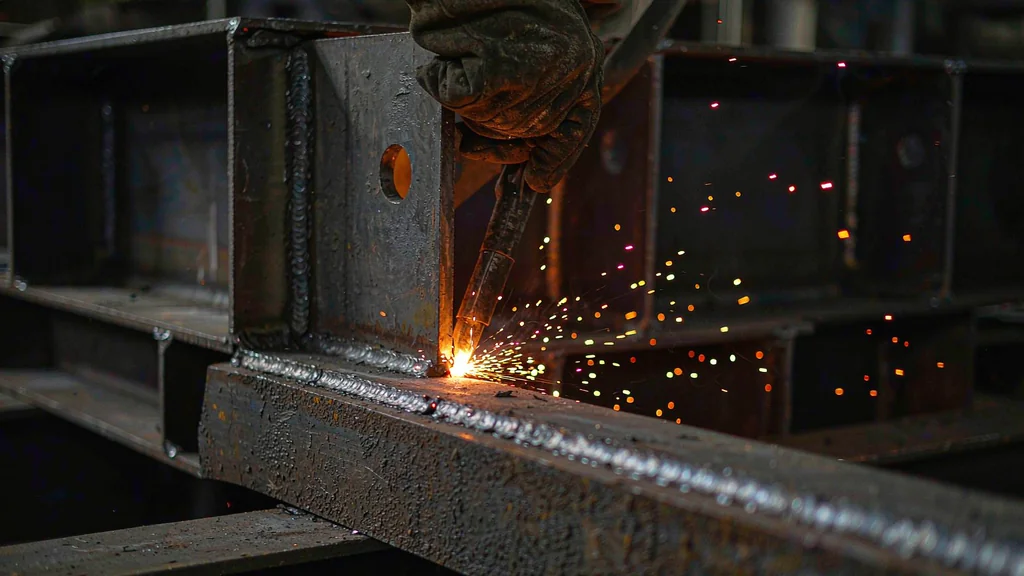
A fabricated quote is not a material price with a markup. It is the sum of seven distinct cost pools, and the raw steel portion is normally less than half of it. Understanding the split is what lets you judge whether a supplier's rate is cheap, fair, or quietly cutting corners.
| Cost Element | Share of Fabricated Price | USD per kg |
|---|---|---|
| Raw steel material | 45 – 55% | $0.42 – $0.70 |
| CNC cutting, drilling and fit-up | 8 – 12% | $0.08 – $0.16 |
| Welding (consumables plus labour) | 10 – 15% | $0.10 – $0.20 |
| Shot blasting and surface preparation | 5 – 8% | $0.05 – $0.10 |
| Painting or hot-dip galvanizing | 6 – 12% | $0.06 – $0.16 |
| Inspection, documentation and packaging | 3 – 5% | $0.03 – $0.07 |
| Factory overhead and margin | 8 – 12% | $0.08 – $0.16 |
That last line is worth dwelling on. A factory margin of 8–12% on a fabricated package is normal and healthy. When a per kg quote comes in 25% below the market, the margin is not the thing that has been removed — the welding hours, the blasting, or the inspection have been. On a 200-tonne warehouse order, the difference between a properly blasted and a skip-blasted frame is around $10,000 in saved cost, spent later as premature coating failure and touch-up.
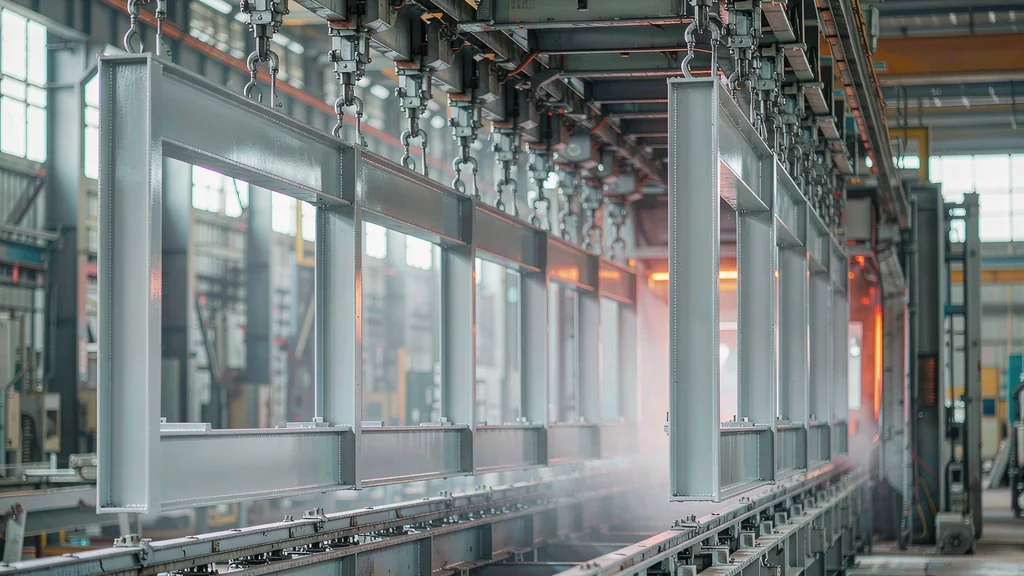
The coating line deserves separate attention because it is the single most variable element after material. A C2 interior paint system might add $0.05/kg. A C5-M marine-grade system with a 240-micron DFT multi-coat build, suitable for a coastal or high-humidity site, can add $0.15/kg or more. Our corrosion protection guide from C1 to C5 explains how to identify which environment class your site actually falls into before you over- or under-specify coatings.
How Does the Price Per Kg Change by Structure Type?
Complexity, not tonnage, sets the ceiling on the per kg rate. Two buildings can weigh the same and differ by 40% in unit price, because one is a repetitive portal frame and the other is a node-welded space frame with hundreds of unique members.
| Structure Type | Weight (kg/m²) | Fabricated Price (USD/kg) | What Drives the Rate |
|---|---|---|---|
| Single-span portal frame, no crane | 25 – 35 | $0.90 – $1.10 | Repetitive members, simple bolted joints |
| Portal frame with 5–10 t overhead crane | 35 – 45 | $1.00 – $1.20 | Heavier columns, crane brackets and rails |
| Multi-span industrial shed | 40 – 60 | $1.05 – $1.30 | More connections, higher total tonnage |
| Mezzanine or multi-storey frame | 50 – 80 | $1.10 – $1.35 | Composite beams, dense fit-up, fire protection |
| Space frame or long-span roof | 30 – 55 | $1.15 – $1.45 | Tube cutting, node welding, tolerance control |
| Heavy industrial, 20 t+ crane, tall eave | 60 – 90 | $1.20 – $1.50 | Plate girders, thick sections, NDT requirements |
How Do You Convert a Per Kg Price Into a Project Budget?
Converting a per kg rate into a real budget takes four steps, and most budget surprises happen because buyers stop after step two.
Step 1: Estimate the tonnage. Multiply the floor area by a steel weight factor for your building type. A 2,000 m² warehouse with no crane, using the 30–35 kg/m² band above, comes to 60–70 tonnes. Our step-by-step structural steel estimating guide works through the weight factors in detail.
Step 2: Apply the fabricated rate. 65 tonnes at $1,100/tonne gives $71,500 FOB. Dividing back gives $1.10/kg — check that against the table above before accepting it.
Step 3: Add freight and insurance. For a 40-foot container carrying roughly 25 tonnes of fabricated steel, ocean freight plus insurance typically adds $70–$150 per tonne depending on route and season. On 65 tonnes that is about $4,600–$9,750, or $0.07–$0.15/kg. This is the step where FOB and CIF quotes stop being comparable.
Step 4: Add everything that is not the steel frame. Foundations, cladding, roof and wall panels, doors, ventilation, erection labour and site supervision together often match or exceed the frame cost. The frame is usually 25–40% of a finished building budget, which is why a 15% movement in the per kg rate changes the total project cost by only 4–6%.
> Our finding: Across our own export orders, buyers who request a per tonne rate alongside the area rate catch scope gaps roughly twice as often as buyers who accept a lump-sum figure. The unit rate forces both sides to name what is and is not included.
You can run the first two steps yourself in under a minute with the steel structure cost calculator, then bring the resulting tonnage to a factory for a firm per kg rate.
Five Factors That Move the Price Per Kg
Understanding what shifts the rate explains why two quotes for a similar-looking building can legitimately differ.
Steel mill index. Hot-rolled coil and section prices are the dominant input, and fabricated rates track the global benchmarks published by industry bodies such as the World Steel Association with a few weeks' lag. When the mill index rises, no factory can absorb that indefinitely, which is why quotations carry validity periods — typically 15 to 30 days.
Order quantity. Fabrication is a fixed-cost business at the setup level. Program files, jigs, blasting batches and container loading all cost roughly the same whether you order 20 tonnes or 200. Below 20 tonnes, expect the per kg rate to climb; above 100 tonnes, there is real room to negotiate.
Section complexity. Universal beams and columns fabricated from standard rolled sections are the most economical. Plate girders, tapered built-up members, curved sections and tubular node structures each add cutting, welding and dimensional-control hours.
Surface protection specification. As noted, coating can swing the rate by $0.10/kg or more. Specifying C5-M for an inland site is a common and expensive over-specification; specifying C2 for a coastal site is a far more expensive under-specification.
Inspection and certification scope. Third-party inspection, ultrasonic or magnetic particle testing of full-penetration welds, mill certificates with traceability, and CE marking documentation all carry real labour and administration cost — usually $0.02–$0.05/kg, and worth every cent on a commercial project.
When a Per Kg Price Is Too Good to Be True
Because raw steel is 45–55% of the price, no factory can discount deeply below the mill index without removing something. These are the specific things to check when a rate arrives far below the market.
- Welding hours. Ask for the welder qualification records and the welding procedure specification. If the factory cannot produce them, the welds were not controlled.
- Surface preparation grade. Ask whether blasting is to Sa 2.5. "Blasted" alone is not a specification.
- Coating thickness. Request the dry film thickness in microns and the number of coats specified, not the brand name.
- Steel traceability. Mill certificates should map to the heat numbers on the delivered members. Ask to see the mapping.
- Connection design. Cheap quotes often assume simple pinned connections. If your design requires moment connections, the price will move once the factory reads the drawings.
How Do You Get a Comparable Per Kg Quote?
Send every factory the same eight data points, and the per kg rates you get back will finally be comparable:
- Building type, length, width, eave height and roof pitch
- Clear span and whether cranes are required, with capacity and duty class
- Location and the governing wind and snow loads, or the applicable design code
- Steel grade required, such as Q355B or S355JR
- Corrosion environment class and the coating system you expect
- Quantity in tonnes, or enough geometry for the factory to estimate it
- Incoterm and destination port
- Inspection, testing and documentation requirements
Frequently Asked Questions
Is structural steel priced per kg or per tonne?
Both, and the two are interchangeable — one tonne equals 1,000 kg, so $1,100 per tonne is $1.10 per kg. Export quotations for structural steel are usually written per tonne because order volumes are large, while retail and small-fabrication quotes often use per kg. Always confirm which unit a quote uses before comparing, because a figure of "1.10" means very different things under each convention.
What is the price of 1 kg of structural steel in 2026?
Raw mill sections cost roughly $0.55–$0.75 per kg in 2026. Fabricated structural steel, cut, welded, blasted, painted and inspected, costs $0.90–$1.50 per kg depending on complexity and coating specification. The per kg figure rises with order size reductions, higher steel grades, more demanding corrosion classes and heavier inspection requirements.
Why is fabricated steel so much more expensive per kg than raw steel?
Because raw material is only 45–55% of a fabricated price. The remainder pays for CNC cutting and drilling, welding labour and consumables, shot blasting, coating application, dimensional inspection, documentation and packaging. When you buy fabricated steel you are buying guaranteed geometry and documented weld quality, not just metal.
Does the price per kg include shipping?
Usually not. A per kg rate is normally quoted FOB at the Chinese port, which covers fabrication, coating, packing and loading. Freight and insurance to your destination port add roughly $0.07–$0.15 per kg for typical export shipments. Confirm the Incoterm in writing before comparing any two rates.
How many kg of steel does my building need?
Multiply the floor area by a weight factor based on the structure type. A standard warehouse with no crane uses 25–35 kg/m²; a crane building 35–45 kg/m²; a multi-storey or mezzanine frame 50–80 kg/m²; and a long-span space frame 30–55 kg/m². A 2,000 m² warehouse therefore needs roughly 60–70 tonnes of structural steel. The structural steel estimating guide works through the calculation in detail.
Conclusion
The per kg price of structural steel is a scope statement disguised as a number. In 2026, fabricated structural steel from a Chinese factory costs $0.90 to $1.50 per kg, of which raw material is less than half. The rate rises with span, crane capacity, connection complexity and coating class, and it falls with order volume — but it never falls below the mill index without something being removed.
Use the range as a sanity check, the cost breakdown as a negotiation tool, and the eight-point quote request as the only way to compare suppliers fairly. If a rate comes back outside the range, ask what is excluded rather than assuming you found a bargain.
Send us your building dimensions, span and destination port and we will return a firm per kg rate with the tonnage breakdown shown separately, so you can see exactly what you are paying for. Reach us on WhatsApp at +86 16650735555 or by email at [email protected].
Related Articles
How to Estimate Structural Steel: A Step-by-Step Guide for 2026
How to estimate structural steel in 6 steps: calculate floor area, apply tonnage factors, convert price to cost per m2, add fabrication, shipping and erection.
How to Budget a Steel Structure Project: Real Costs
Step-by-step guide to budgeting a steel structure project in 2026. 10 cost lines you must include. Avoid the 30-50% budget overrun that traps 68% of
Need a Steel Structure?
Get a free quote from our engineering team. We respond within 2 hours.
Request a QuoteStay Updated
Get steel structure tips, cost guides, and industry insights delivered to your inbox.
No spam. Unsubscribe anytime.