Steel Structure Building Codes: A Global Comparison Guide
Compare AISC, Eurocode 3, GB, AS/NZS and BS steel building codes. Learn how international buyers navigate compliance across different regions for steel
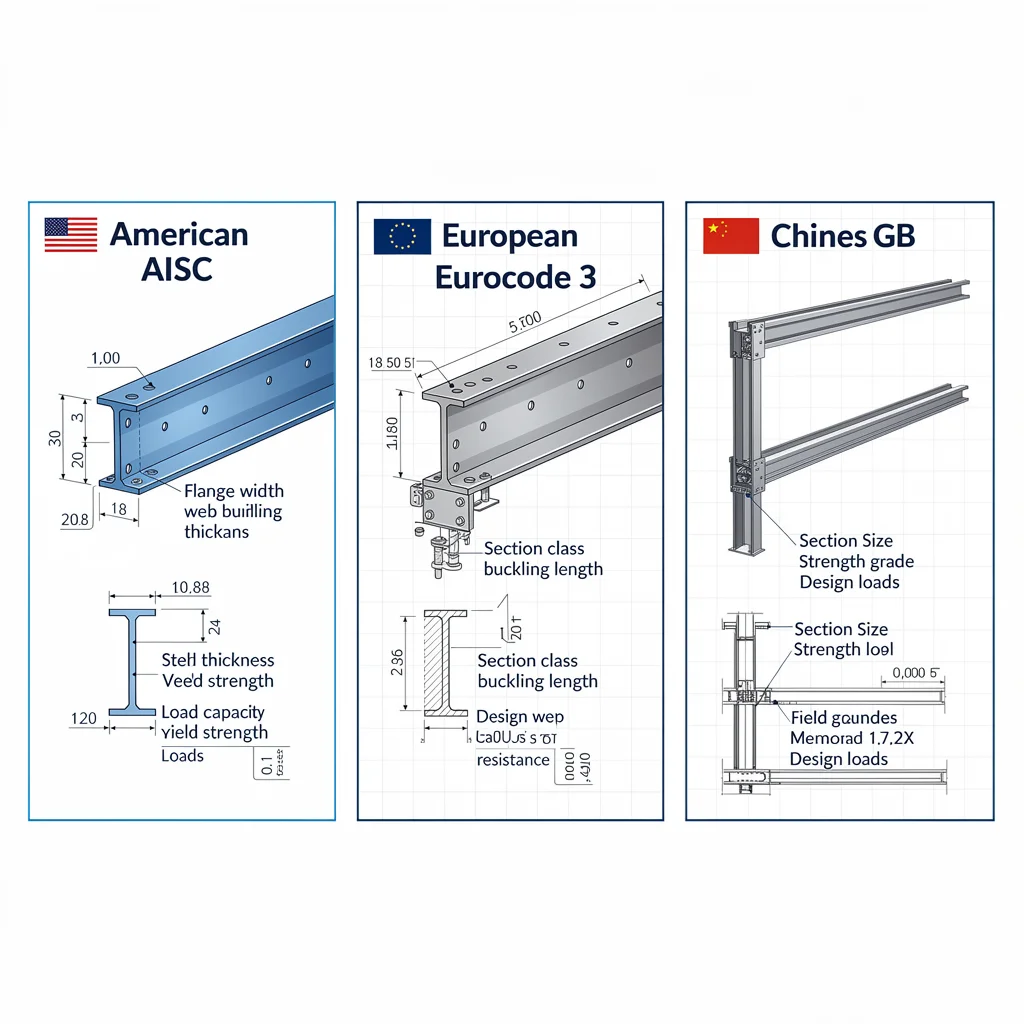
When buying a steel structure from overseas, one question matters more than any other: Which building code does it follow, and will it pass local inspection?
International buyers often assume steel is steel and a building designed in China will work anywhere. In practice, different regions enforce different design codes, load requirements, and material standards. A frame that passes Chinese GB standards may not meet Eurocode 3 requirements for snow loads or seismic resistance.
This guide compares the world's major steel structure design codes and explains what international buyers need to know to ensure compliance.
The Five Major Steel Design Codes
| Code | Full Name | Primary Region | Governing Body |
|---|---|---|---|
| AISC 360 | Specification for Structural Steel Buildings | United States | American Institute of Steel Construction |
| Eurocode 3 (EN 1993) | Design of Steel Structures | European Union | CEN |
| GB 50017 | Standard for Design of Steel Structures | China | Ministry of Housing and Urban-Rural Development |
| AS/NZS 4100 | Steel Structures Standard | Australia / New Zealand | Standards Australia |
| BS 5950 | Structural Use of Steelwork in Building | United Kingdom | BSI (being replaced by Eurocode) |
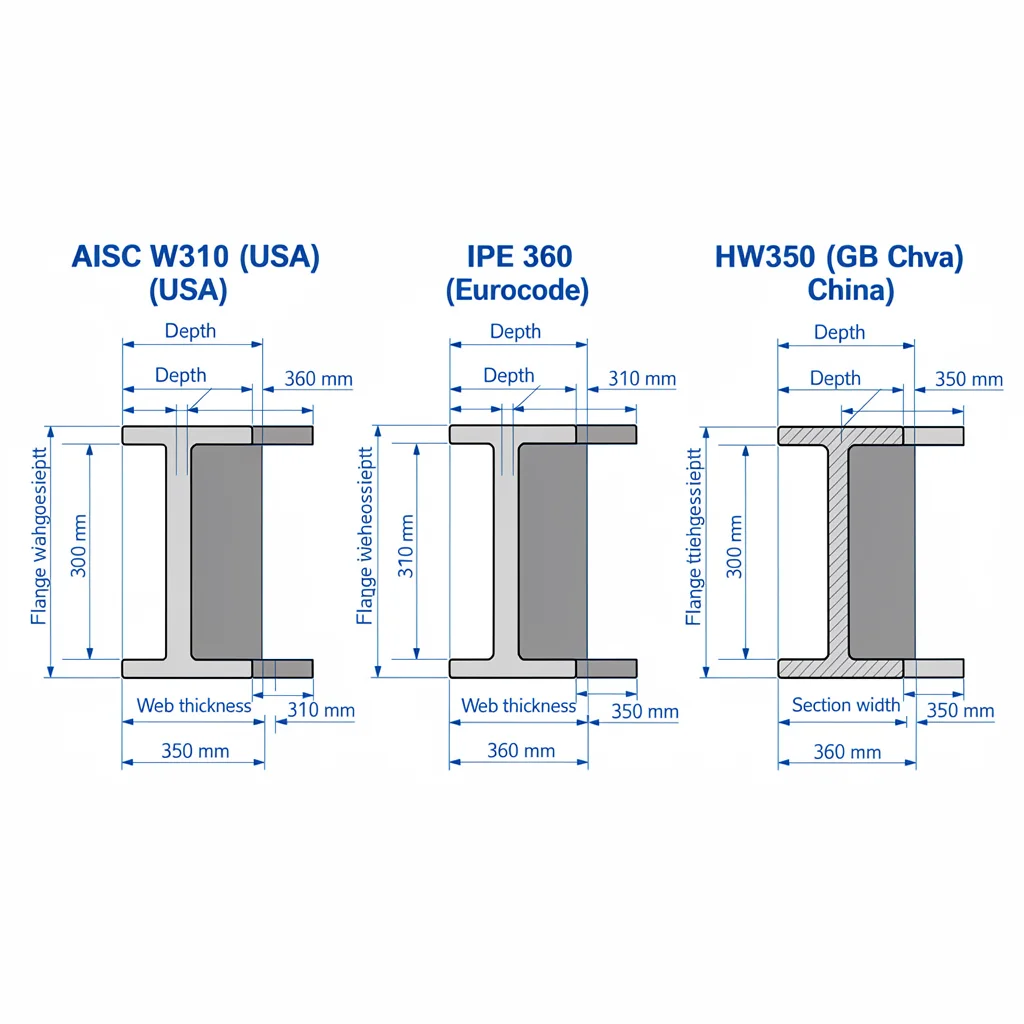
, but they differ in their approach to loads, material properties, and connection design.
AISC 360 (USA): Performance-Based Design
The American standard is the most widely referenced code globally. It uses Load and Resistance Factor Design (LRFD) as the primary method, with Allowable Stress Design (ASD) as an alternative.
Key characteristics:
- Material grades: ASTM A992 (wide flange), ASTM A36 (angles/plates), ASTM A572 Grade 50 (high-strength)
- Seismic provisions: Separate standard AISC 341 for seismic design (essential for California, Alaska)
- Wind loads: Follow ASCE 7 (referenced standard, not part of AISC itself)
- Connection design: Heavily relies on AISC Manual tables and pre-qualified connections
Eurocode 3 (EN 1993): Limit State Design
Eurocode 3 is the unified European standard, adopted by all EU member states plus Norway, Switzerland, and Turkey. Each country publishes a National Annex that adjusts parameters for local conditions.
Key characteristics:
- Material grades: S235, S275, S355, S460 (increasing yield strength)
- Partial safety factors: Different from AISC — generally more conservative for certain failure modes
- Fire design: EN 1993-1-2 provides detailed fire resistance calculation methods (more prescriptive than AISC)
- Fatigue: EN 1993-1-9 covers fatigue design in greater detail than AISC
GB 50017 (China): Fast and Cost-Effective
China's national standard GB 50017 is the most commonly used code for domestic Chinese projects. It follows a limit state design philosophy similar to Eurocode but with different safety factors.
Key characteristics:
- Material grades: Q235 (equivalent to A36/S235), Q355 (equivalent to A572-50/S355), Q420, Q460
- Load combinations: Similar to Eurocode but with different partial factors
- Seismic design: GB 50011 (seismic code) has strict requirements for steel structures in seismic zones
- Economy: GB code often produces lighter sections than AISC or Eurocode for equivalent loads
AS/NZS 4100 (Australia/New Zealand): Site-Specific Loads
Australia and New Zealand have unique loading conditions — high wind in cyclone-prone regions, significant seismic activity in New Zealand, and aggressive corrosion in coastal areas.
Key characteristics:
- Wind loads: AS/NZS 1170.2 includes detailed regional wind speed maps (cyclonic vs non-cyclonic)
- Corrosion: AS 4312 provides atmospheric corrosivity categories specific to Australian locations
- Material grades: Grade 300 (similar to A572-50), Grade 350 — both commonly available
- Bolting: AS 1252 requires specific bolt grades (8.8/S, 10.9/S) for structural connections
BS 5950 (UK): Legacy Standard Still in Use
The UK transitioned from BS 5950 to Eurocode 3 (BS EN 1993) as the primary standard. However, many existing buildings were designed to BS 5950, and some extensions or renovations still reference it.
Key characteristics:
- Material grades: S275 and S355 (same as Eurocode)
- Design method: Historically used limit state design similar to Eurocode
- Current status: Superseded by Eurocode 3 but still referenced for existing structures
How Codes Compare: A Practical Example
Let's compare the design of a simple steel column for a 10m × 30m warehouse in different code jurisdictions.
| Parameter | AISC (USA) | Eurocode 3 (EU) | GB (China) | AS/NZS (Australia) |
|---|---|---|---|---|
| Steel grade | A992 (345 MPa) | S355 (355 MPa) | Q355 (355 MPa) | Grade 300 (300 MPa) |
| Dead load factor | 1.2 | 1.35 | 1.2 | 1.2 |
| Live load factor | 1.6 | 1.5 | 1.4 | 1.5 |
| Wind load factor | 1.0 (LRFD) | 1.5 | 1.4 | 1.0 |
| Column section | W310×79 | IPE 360 | HW350×350 | 310UC96.8 |
| Relative weight | ~79 kg/m | ~72 kg/m | ~70 kg/m | ~97 kg/m |
Can a Chinese Manufacturer Design to International Codes?
Yes — and this is one of the most important questions to ask when sourcing steel structures from China.
What to request from your fabricator:
- Design code specification — State in your contract: "Design to [AISC 360 / Eurocode 3 / AS/NZS 4100]"
- Material certification — Chinese mills can produce Q355 steel that meets S355 (Eurocode) or A572-50 (ASTM) requirements. Request mill certificates showing mechanical properties
- Third-party verification — Many international buyers hire an independent engineer or inspection company (SGS, Bureau Veritas) to verify the design
- CE marking — For European projects, ensure the fabricator has FPC certification from a notified body
- Weld procedures — WPS/PQR should be qualified to the target code (e.g., ASME IX for AISC, EN ISO 15614 for Eurocode)
How to Verify Compliance Before Purchase
| Step | What to Check | Documentation Required |
|---|---|---|
| 1 | Does the fabricator have experience with your target code? | Project references, case studies |
| 2 | Are the steel grades available in your country? | Mill certificates, material test reports |
| 3 | Does the design meet local wind/snow/seismic loads? | Structural calculations, signed by a licensed engineer |
| 4 | Are the bolt and weld specifications compatible? | Bolt certificates, WPS/PQR documents |
| 5 | Does the paint system comply with local environmental regulations? | Coating specification, VOC compliance data |
| 6 | Has a third-party inspection been conducted? | Inspection reports (SGS, BV, TUV) |
Frequently Asked Questions
Q: Do I need a local engineer to review drawings from a Chinese fabricator? A: Strongly recommended. A local engineer can verify that the design meets local codes and stamp the drawings for building permit approval.
Q: Can the same steel frame be used in different countries? A: Technically yes, but the design loads (wind, snow, seismic) likely differ. Each project should be designed specifically for its location.
Q: Is Chinese Q355 steel the same as S355 (European) or A572-50 (American)? A: Close but not identical. Q355 has similar yield strength (355 MPa) but different chemical composition limits. Most engineers accept it as equivalent when supported by mill certificates.
Q: How long does it take to redesign from GB to AISC or Eurocode? A: Typically 1-2 weeks for a standard warehouse design. Complex projects with seismic requirements may take 3-4 weeks.
Conclusion
Steel structure design codes vary significantly across regions, but experienced Chinese manufacturers can produce compliant structures for any market. The key is clear communication, proper documentation, and third-party verification.
Whether you're building in Dubai, Lagos, Manila, or Sydney, a reputable fabricator can deliver a code-compliant steel structure — but only if the correct code is specified from day one.
Need a code-compliant steel structure for your project? Contact Laotie Steel for a free design review. Our engineers are experienced with AISC, Eurocode 3, AS/NZS, and GB standards and can provide a compliance-ready quote within 24 hours.
*Laotie Steel Structure Co., Ltd. — CE and ISO 9001 certified manufacturer. Over 5,000 tons monthly production capacity. Serving 30+ countries worldwide.*
Related Articles
Steel Structure Engineering: Design to Construction Workflow
Complete guide to steel structure engineering workflow. Learn each phase from design analysis and connection detailing to fabrication, shipping, and on-site
Crane Beam Design Guide: Steel Structure Loads, Span & Cost
Complete guide to crane beam design for steel structures. Learn overhead crane types, wheel load calculation, span design, connection details, and cost factors.
Need a Steel Structure?
Get a free quote from our engineering team. We respond within 2 hours.
Request a QuoteStay Updated
Get steel structure tips, cost guides, and industry insights delivered to your inbox.
No spam. Unsubscribe anytime.