Steel Warehouse Design: Spans, Cranes & Cladding Options
Complete guide to steel warehouse design: clear span vs multi-span, crane beam systems, overhead crane integration, roof and wall cladding selection, and
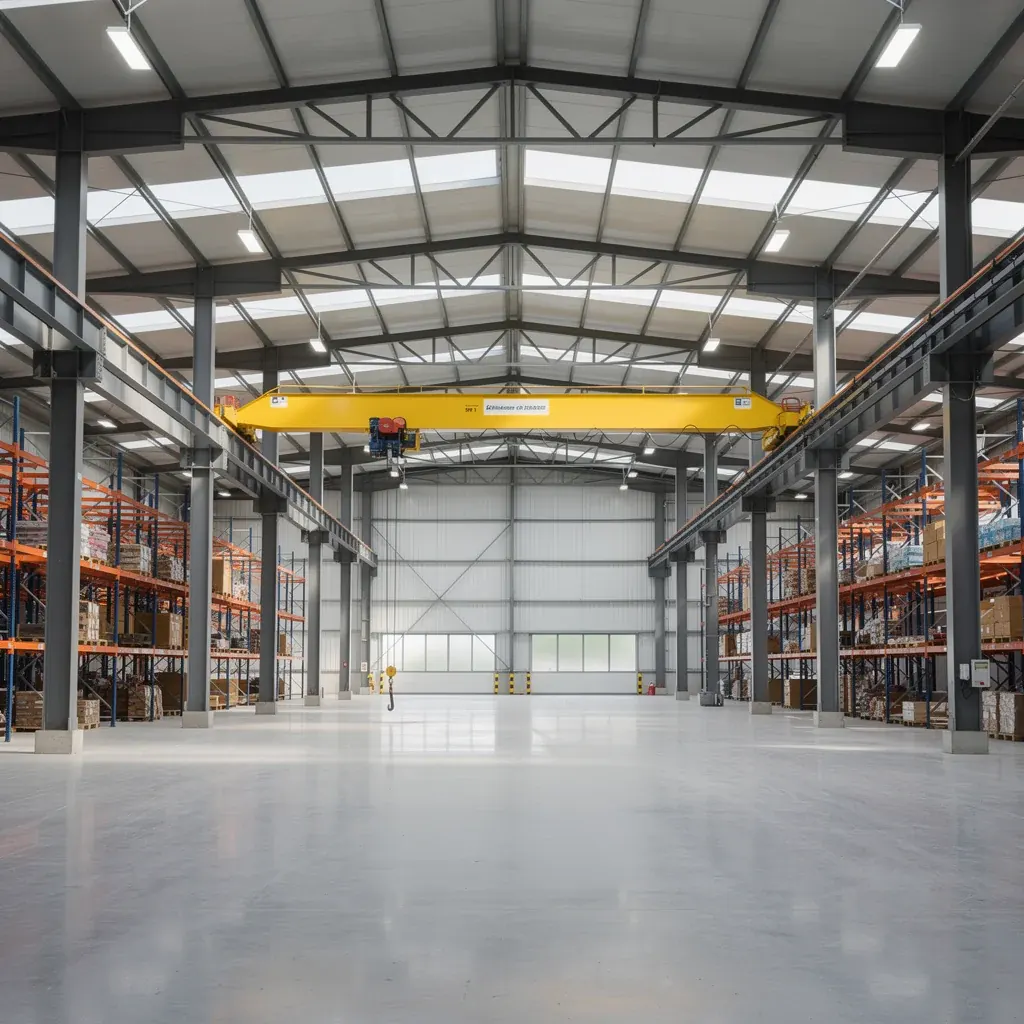
Designing a steel warehouse involves more than just choosing a size. The right design decisions directly impact your building's functionality, construction cost, and long-term operational efficiency.
Span Configuration
Clear span (single bay, no interior columns): Best for 12–30m widths. Provides unobstructed floor space but heavier frames for spans over 30m.
Multi-span (multiple bays with interior columns): More economical for buildings wider than 40m. A 60m wide building as 2×30m spans saves 15–20% in steel weight.
Bay Spacing Optimization
Bay spacing (the distance between main frames along the building length) significantly affects total steel weight:
| Bay Spacing | Steel Weight Impact | Best For |
|---|---|---|
| 6m | Baseline (+0%) | Light loads, low eave height |
| 7.5m | +3–5% | Optimal balance of cost and layout |
| 9m | +8–12% | Large trucks, wide aisles |
| 12m | +15–25% | Very large equipment, hangars |
Crane Systems
| Crane Type | Capacity | Best For | Rail Mounting |
|---|---|---|---|
| Underhung | 1–10 tons | Light manufacturing | Suspended from roof rafters |
| Single girder | 5–20 tons | General warehouse | Column-mounted brackets |
| Double girder | 10–100 tons | Heavy industry | Column-mounted brackets |
Crane Runway Beam Design
Crane runway beams must be designed for both vertical wheel loads and lateral surge forces. Key considerations:
- Fatigue design: For cranes with >50,000 cycles, use fatigue-resistant connections
- Crane girder deflection: Limit vertical deflection to L/600 (1.5mm per meter span)
- End stops: Install buffer stops at runway ends with 50% energy absorption capacity
- Service platforms: Include walkways on both sides of runway beams for maintenance access
Cladding Options
| Type | U-Value (W/m²K) | Fire Rating | Best Application | Cost Index |
|---|---|---|---|---|
| Single-skin steel sheet | 5.0–6.0 | Non-rated | Uninsulated warehouses | 1.0x |
| PIR sandwich panel | 0.22–0.28 | Class B | Cold storage, insulated | 2.0x |
| Rock wool panel | 0.40–0.55 | Class A (fire-rated) | Fire-rated buildings | 2.3x |
| Composite panel (EPS) | 0.30–0.45 | Class B | Budget insulated | 1.5x |
Roof Design Considerations
Roof Slope
- 5–10° (low slope): Most common for steel buildings, economical, good drainage
- >15° (steep slope): Aesthetic preference, higher wind loads, more steel required
- Flat roof (<3°): Requires standing seam system with guaranteed waterproofing
Natural Lighting
- Install translucent panels (FRP or polycarbonate) at 5–8% of roof area
- Reduces daytime lighting costs by 40–60%
- Position along ridge lines for even light distribution
Loading Dock Design
| Dock Feature | Standard Spec | Heavy Duty Spec |
|---|---|---|
| Dock height | 1.2–1.4m (truck bed height) | 1.2–1.4m |
| Dock width per bay | 3.0–3.5m | 3.5–4.0m |
| Dock leveler capacity | 6,000 kg | 10,000 kg |
| Dock shelter | Fabric curtain | Insulated shelter (cold climate) |
| Dock pit drainage | Not required | Required (below grade) |
Ventilation & Fire Protection
Natural ventilation: Ridge ventilators (continuous or unit type) provide passive airflow. Requirement: 1–2% of roof area as openable vents.
Smoke ventilation: In fire-rated buildings, automatic smoke vents at 33m spacing with fusible links. Required by most building codes for warehouses >3,000 m².
Fire protection: Steel columns in fire-rated zones require intumescent coating or fire-rated board cladding. Typical fire resistance: 60–120 minutes depending on building use.
Structural Load Combinations
A properly designed warehouse must simultaneously resist:
- Dead load: Self-weight of steel frame + cladding (0.3–0.6 kN/m²)
- Live load: Roof access + maintenance (0.5–1.0 kN/m²)
- Wind load: Based on local wind speed and building height (0.5–2.5 kN/m²)
- Snow load: Regional — up to 3.0 kN/m² in cold climates
- Seismic load: Required in seismic zones (IBC/ASCE 7 compliant)
- Crane load: Vertical + lateral + longitudinal (if crane installed)
Cost Optimization Strategies
| Strategy | Savings | Impact |
|---|---|---|
| Use Q355B instead of Q235B | 10–15% steel weight reduction | Minor — requires high-strength welding |
| Optimize bay spacing to 7.5m | 5–8% total cost reduction | None — design decision |
| Z-purlin lapping (continuous span) | 15–25% purlin weight savings | None — standard engineering practice |
| Use pinned base (instead of fixed) | 5–10% foundation savings | Slightly taller columns |
| Standardize column sections | 3–5% fabrication savings | None — procurement efficiency |
Design Checklist
- [ ] Confirm clear span or multi-span based on building width
- [ ] Optimize bay spacing — start at 7.5m
- [ ] Select crane type and capacity (if required)
- [ ] Choose cladding based on insulation needs
- [ ] Determine roof slope (5–10° recommended)
- [ ] Plan natural lighting (5–8% roof area)
- [ ] Design loading docks (if required)
- [ ] Verify fire protection requirements
- [ ] Run full load combination analysis
Related Articles
Steel Structure Seismic Design: Earthquake-Resistant Guide
Complete guide to earthquake-resistant steel structure design. Learn about seismic codes, ductility design, braced frames, base isolation, and cost
Steel Structure Commercial Buildings: Design & Cost Guide
Complete guide to steel structure commercial buildings. Learn about office buildings, retail centers, shopping malls, hotels, and mixed-use developments
Need a Steel Structure?
Get a free quote from our engineering team. We respond within 2 hours.
Request a QuoteStay Updated
Get steel structure tips, cost guides, and industry insights delivered to your inbox.
No spam. Unsubscribe anytime.