Steel Staircase Design Guide: Types, Codes & Cost
Complete steel staircase design guide. Learn types (straight, L-shaped, spiral), IBC/OSHA/Eurocode 3 requirements, riser/tread dimensions, stringer design
Why Steel Staircase Design Matters
A steel staircase is a critical structural and functional element in any multi-story steel building. It carries daily pedestrian traffic, serves as the primary means of egress during emergencies, and must resist both gravity loads and lateral forces from occupant movement. Poor steel staircase design leads to uncomfortable treads, excessive vibration, non-compliant riser heights, and failed inspections — all of which delay project handover and inflate cost.
This guide covers everything you need to specify a code-compliant steel staircase: types, code requirements (IBC, OSHA, Eurocode 3), riser and tread dimensions, load requirements, stringer design, handrail rules, fire protection, and realistic cost per flight. For broader context on how staircases integrate into multi-level frames, see our multi-story steel structure design guide.

Types of Steel Staircases
Steel staircases come in several configurations, each suited to different building functions, space constraints, and aesthetic goals. Selecting the right type early in design prevents costly rework later.
Straight Staircase
A straight staircase runs continuously in one direction without any change in direction or landing. It is the simplest and most economical type, easy to fabricate and install. Straight flights are common in warehouses, factories, and industrial plants where function outweighs appearance. Maximum flight length is typically limited to 12 risers before an intermediate landing is required by code.
L-Shaped and U-Shaped Staircase
L-shaped stairs turn 90 degrees at a landing, while U-shaped stairs reverse 180 degrees at a landing. Both types are used when the available floor space cannot accommodate a single straight run, or when landings are required for code compliance. The landing also provides a resting point, which improves safety for elderly occupants and reduces fall distance.
Spiral Staircase
Spiral staircases wind around a central column, occupying a very small footprint. They are popular for secondary access, rooftop equipment platforms, and architectural feature stairs. However, most building codes restrict spiral stairs to private dwellings or low-occupancy access — they are generally not permitted as primary egress in commercial buildings.
Industrial Staircase
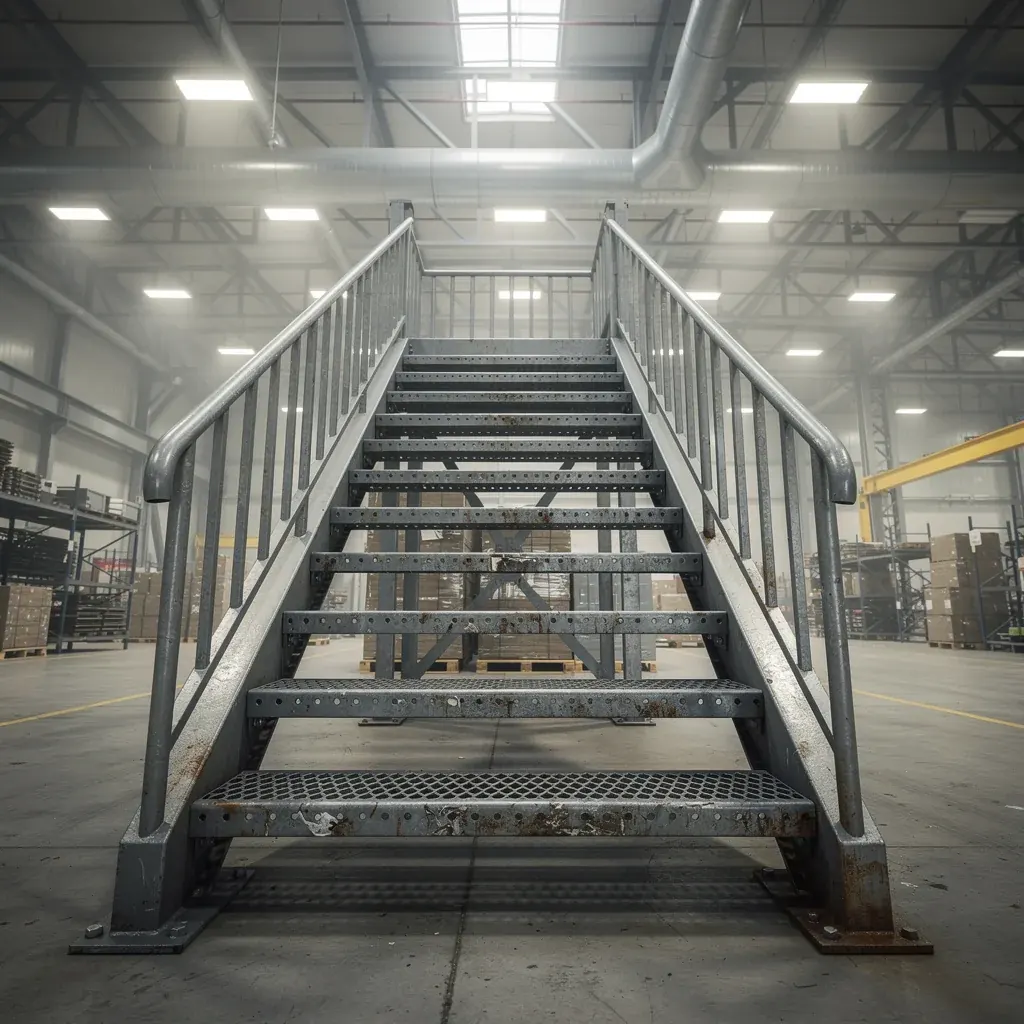
Industrial stairs are designed for factories, warehouses, and process plants. They typically have open grated treads, steel stringers, and heavy-duty handrails. OSHA governs industrial stair design in the United States, with different requirements from IBC-compliant commercial stairs.
| Staircase Type | Typical Use | Cost Index | Code Restriction |
|---|---|---|---|
| Straight | Warehouses, factories | 1.0 (baseline) | Max 12 risers per flight (IBC) |
| L-shaped / U-shaped | Offices, commercial | 1.2-1.4 | Landing required at turn |
| Spiral | Secondary access, residential | 1.5-1.8 | Not primary egress in commercial |
| Industrial (OSHA) | Plants, equipment access | 0.9-1.1 | Open treads permitted |
Steel Staircase Code Requirements
Steel staircase design is governed by multiple codes depending on building use and jurisdiction. The three most referenced standards are IBC, OSHA, and Eurocode 3. For a side-by-side comparison of global steel structure codes, see our building codes and standards guide.
IBC (International Building Code)
IBC applies to commercial, residential, and institutional buildings in most US jurisdictions. Key staircase requirements include:
- Minimum width: 44 inches (1120 mm) for occupant load ≥ 50, 36 inches (914 mm) for smaller occupant loads
- Riser height: 4-7 inches (102-178 mm), max 7 inches for commercial
- Tread depth: minimum 11 inches (279 mm)
- Number of risers per flight: maximum 12
- Handrail height: 34-38 inches (864-965 mm) above tread nosing
- Headroom: minimum 80 inches (2032 mm) measured vertically
OSHA (Occupational Safety and Health Administration)
OSHA standards (1910.25) apply to industrial stairways used for equipment access, maintenance, and industrial processes. OSHA stairs are more permissive than IBC:
- Minimum width: 22 inches (559 mm)
- Riser height: 6.5-9.5 inches (165-241 mm)
- Tread depth: minimum 9.5 inches (241 mm)
- Handrail height: 30-37 inches (762-940 mm)
- Open risers and open grating treads are permitted
Eurocode 3 (EN 1993)
Eurocode 3 governs structural steel design in the EU and many international markets. Staircase geometry is also coordinated with EN 1991-1-1 (imposed loads). Typical requirements:
- Minimum width: 1000 mm for escape routes, 1200 mm for high-occupancy buildings
- Riser height: ≤ 190 mm for commercial buildings
- Tread depth: ≥ 250 mm
- Handrail height: 900-1000 mm
- Live load: 3.0-5.0 kN/m² depending on building category
Riser and Tread Dimensions
Comfortable and code-compliant riser/tread proportions follow two well-known rules:
- Blondel's formula: 2R + T = 630-650 mm (where R = riser, T = tread)
- Sum rule: R + T ≈ 430-470 mm
Recommended Dimensions by Building Type
| Building Type | Riser (mm) | Tread (mm) | Slope Angle |
|---|---|---|---|
| Residential | 170-190 | 250-270 | 32-37° |
| Commercial | 150-175 | 280-300 | 27-32° |
| Industrial (OSHA) | 200-240 | 250-280 | 38-44° |
| Public assembly | 150-165 | 300-320 | 25-29° |
Load Requirements
Steel staircase design must account for both gravity loads and dynamic effects from human movement.
Live Load
- IBC residential: 40 psf (1.92 kN/m²)
- IBC commercial / public: 100 psf (4.79 kN/m²) — typical for offices and retail
- IBC assembly areas: 100 psf (4.79 kN/m²), up to 125 psf for stages
- Eurocode 3: 3.0-5.0 kN/m² depending on building category
- OSHA industrial: designed for moving concentrated load of 1000 N (≈ 225 lb)
Concentrated Load
In addition to uniform live load, treads and landings must resist a concentrated load of approximately 1.5-2.0 kN applied on a 100×100 mm area at any point. This prevents local failure from a heavy individual standing on one tread.
Dynamic and Vibration Check
Long-span steel stairs are lightweight and prone to perceptible vibration under footfall. The natural frequency should be kept above 5-8 Hz to avoid occupant discomfort. If vibration is excessive, options include stiffer stringers, added damping, or tuned mass dampers.
Stringer Design
The stringer is the main structural member that supports the treads and transfers load to the landings or floors. Most steel staircases use one of three stringer configurations:
Single Central Stringer
A single central stringer (often a steel box section or plate girder) supports treads on both sides. This produces a sleek, floating appearance but requires careful torsion analysis, since eccentric loading on one tread creates torsion in the stringer.
Twin Stringers (Side Stringers)
Two parallel stringers run along the outer edges of the stair. This is the most common industrial and commercial configuration. Each stringer acts as a simply supported or continuous beam, and design is straightforward. Channel sections (MC, C) or wide-flange sections (W) are typical.
Mono-Stringer with Cantilever Treads
A single stringer with treads cantilevered to one or both sides offers a strong architectural statement. Cantilever connections must be carefully detailed to resist fatigue from cyclic foot loading.
Stringer Sizing Procedure
- Calculate factored uniform load (dead + live) per linear meter
- Determine maximum bending moment and shear for the span
- Select section modulus to satisfy bending strength per AISC 360 or EN 1993-1-1
- Check deflection: typically L/360 for live load, L/240 for total load
- Verify vibration performance (natural frequency > 5 Hz)
- Design connection plates, welds, or bolts at landings

Handrail and Guardrail Requirements
Handrails and guardrails are safety-critical components with strict code requirements.
Handrail
- Height: 34-38 inches (IBC), 900-1000 mm (Eurocode)
- Graspable cross-section: 1.25-2.0 inches (32-51 mm) diameter, or equivalent
- Continuity: must be continuous along the full flight, returned at ends
- Mounting: must resist 200 lb (890 N) concentrated load in any direction
Guardrail
- Required height: 42 inches (1067 mm) above landing for IBC, 1000 mm for Eurocode
- Infill: intermediate rails or panels must prevent passage of a 4-inch (102 mm) sphere
- Load: 50 lb/ft (0.73 kN/m) horizontal load at top rail
Fire Protection
Steel staircases in commercial and multi-story buildings typically require fire-rated construction because they serve as means of egress.
- IBC requirement: stair enclosures in most occupancy types require 1-hour or 2-hour fire rating
- Protection methods: intumescent paint (1-2 hour rating), spray-applied fire-resistive materials (SFRM), or gypsum board enclosure
- Industrial stairs: often exempt from fire rating when located in non-combustible single-use buildings
- Cost impact: fire-rated finishes add 15-30% to staircase cost
Steel Staircase Cost per Flight
Cost varies widely with type, finish, fire rating, and location. The table below gives indicative ranges for a single straight flight (12 risers, 1.2 m wide) in 2026:
| Configuration | Cost Range (USD) | Notes |
|---|---|---|
| Industrial OSHA (grated treads) | $2,500 - $4,500 | Painted finish, no fire rating |
| Commercial IBC (concrete-filled pan) | $6,000 - $10,000 | Painted or galvanized |
| Architectural central stringer | $12,000 - $25,000+ | Stainless or powder-coated |
| Spiral staircase | $5,000 - $15,000 | Diameter-dependent |
| Fire-rated (2-hour) commercial | $9,000 - $14,000 | Includes intumescent coating |
Common Steel Staircase Design Mistakes
- Ignoring vibration — long-span lightweight stairs feel bouncy; check frequency early
- Non-compliant riser height — even a 5 mm deviation can fail inspection in strict jurisdictions
- Under-designed stringer connections — fatigue cracking often starts at the landing weld
- Missing handrail continuity — returns must be continuous, not interrupted at newel posts
- Inadequate headroom — staircases under beams often violate the 80-inch minimum
- No fire protection on egress stairs — a fatal error that blocks occupancy approval
FAQ
What is the minimum width for a steel staircase in a commercial building?
IBC requires a minimum clear width of 36 inches (914 mm) for occupant loads under 50, and 44 inches (1120 mm) for occupant loads of 50 or more. Eurocode 3 typically requires 1000 mm minimum for escape routes.
What is the maximum riser height allowed by code?
IBC limits risers to 7 inches (178 mm) in commercial buildings and 7-3/4 inches (197 mm) in residential. OSHA permits up to 9.5 inches (241 mm) for industrial stairs. Eurocode 3 generally caps risers at 190 mm for commercial use.
How much does a steel staircase cost per flight?
An industrial OSHA-compliant steel flight starts around $2,500-$4,500. A commercial IBC flight with concrete-filled pan treads runs $6,000-$10,000. Architectural central-stringer stairs can exceed $25,000 per flight.
Do steel staircases require fire protection?
In most commercial and multi-story buildings, yes. IBC requires 1- or 2-hour fire-rated enclosures for egress stairs. Intumescent paint, SFRM spray, or gypsum enclosure are common solutions. Industrial stairs in non-combustible buildings are often exempt.
What is the best stringer type for a long-span steel staircase?
Twin side stringers (channel or wide-flange sections) are the most efficient and easiest to design for long spans. Single central stringers offer cleaner aesthetics but require detailed torsion and vibration analysis.
Next Steps
A well-designed steel staircase balances code compliance, occupant comfort, structural efficiency, and cost. By selecting the right staircase type early, verifying riser/tread geometry against Blondel's formula, sizing stringers for both strength and vibration, and detailing handrails and fire protection correctly, you can avoid the most common design failures and deliver a staircase that passes inspection on the first attempt.
If you need help specifying steel staircases for your next project — whether a warehouse, factory, or multi-story building — contact our engineering team for a free design review and quotation.
Related Articles
Steel Structure Seismic Design: Earthquake-Resistant Guide
Complete guide to earthquake-resistant steel structure design. Learn about seismic codes, ductility design, braced frames, base isolation, and cost
Steel Structure Commercial Buildings: Design & Cost Guide
Complete guide to steel structure commercial buildings. Learn about office buildings, retail centers, shopping malls, hotels, and mixed-use developments
Need a Steel Structure?
Get a free quote from our engineering team. We respond within 2 hours.
Request a QuoteStay Updated
Get steel structure tips, cost guides, and industry insights delivered to your inbox.
No spam. Unsubscribe anytime.