Steel Mezzanine Floor Design: Load, Span & Cost Guide
Complete guide to steel mezzanine floor design. Learn load requirements, span design, composite vs non-composite systems, vibration control, and cost per
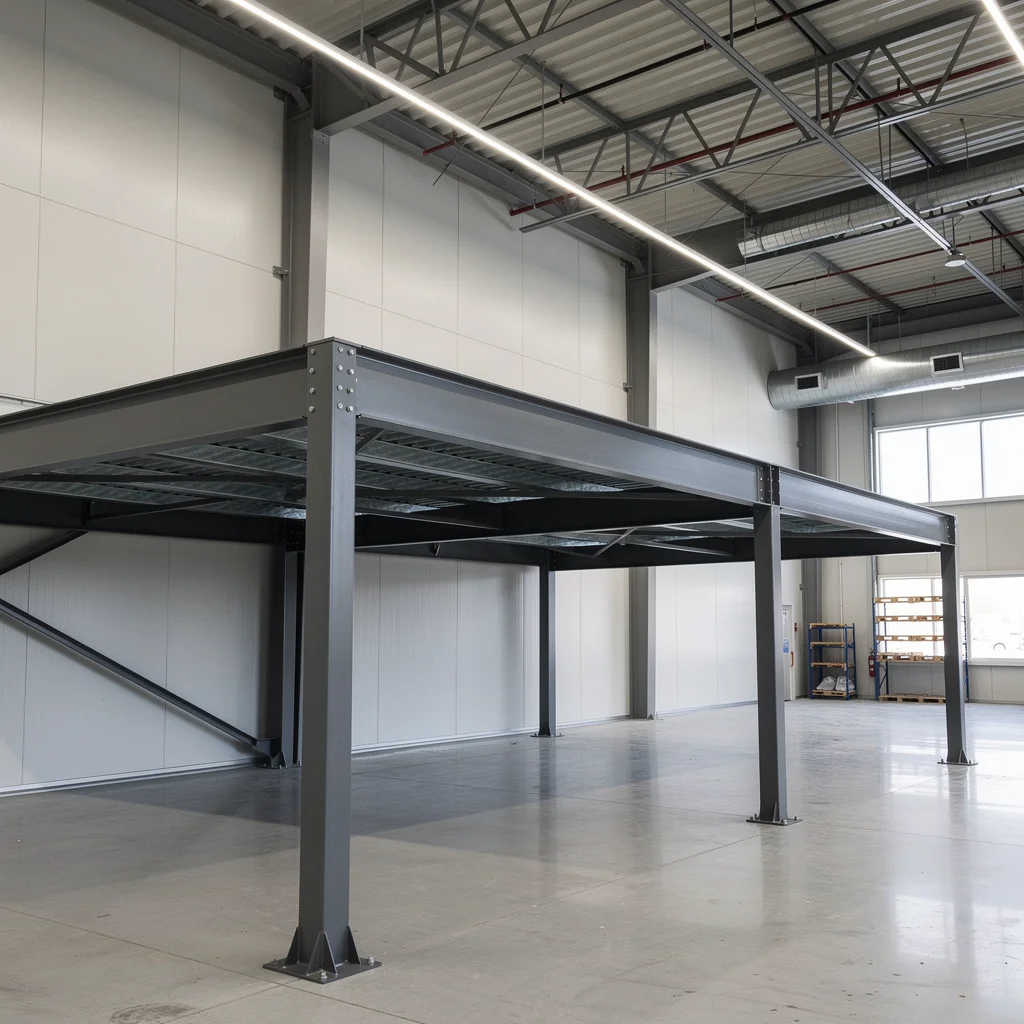
What Is a Steel Mezzanine Floor?
A steel mezzanine floor is an intermediate level built between the main floors of a building, constructed using structural steel framing. Unlike permanent concrete floors, steel mezzanines are semi-permanent, modular, and can be dismantled or relocated when operational needs change. They are widely used in warehouses, distribution centers, manufacturing plants, and retail spaces to double or triple usable floor area without expanding the building footprint.
Steel mezzanine floor design requires careful coordination of loading, span layout, beam selection, vibration performance, and fire protection. A poorly designed mezzanine can suffer excessive deflection, uncomfortable vibration, or even structural failure under heavy storage loads. This guide walks through every key decision so engineers, facility managers, and project owners can specify a mezzanine that is safe, efficient, and cost-effective.

Types of Steel Mezzanine Floors
Full Mezzanine
A full mezzanine covers the entire footprint below and creates a complete second level. This is the most common choice for warehouses that need maximum additional storage or production space. Full mezzanines require stairways, handrails, and often pallet drop gates for material handling.
Partial Mezzanine
A partial mezzanine occupies only a portion of the lower level, leaving open vertical space above for tall equipment, conveyors, or high-bay racking. This is ideal when only a limited area of elevated floor is needed for offices, pick modules, or light assembly.
Catwalk Mezzanine
A catwalk is a narrow elevated walkway used to access equipment, maintenance points, or shelving. Catwalks are lighter in construction and carry lower live loads, making them the most economical mezzanine type per square meter.
| Mezzanine Type | Typical Use | Live Load Range | Relative Cost |
|---|---|---|---|
| Full Mezzanine | Storage, production, offices | 4.8–7.2 kN/m² | High |
| Partial Mezzanine | Pick modules, offices, assembly | 3.6–6.0 kN/m² | Medium |
| Catwalk Mezzanine | Access, maintenance | 2.0–3.6 kN/m² | Low |
Load Requirements for Steel Mezzanine Floors
Live Load
Live load is the movable or variable load on the mezzanine, including people, stored goods, forklifts, and equipment. Most international codes specify minimum live loads based on occupancy:
- Light storage / offices: 4.8 kN/m² (100 psf)
- General warehouse storage: 6.0 kN/m² (125 psf)
- Heavy storage with mobile equipment: 7.2 kN/m² (150 psf) or higher
Dead Load
Dead load includes the weight of the steel framing, decking, concrete topping (if used), finishes, ceiling, and fixed equipment. Accurate dead load estimation is critical because it drives deflection calculations and vibration response. A typical composite mezzanine with 100 mm of lightweight concrete over profiled steel deck weighs around 2.0–2.5 kN/m².
Load Combinations
Design must consider multiple load combinations per the applicable code. For ASCE 7, common combinations include:
- 1.2D + 1.6L
- 1.2D + 1.0L + 0.5S
- 1.4D
Span Design: Primary and Secondary Beams
Beam Grid Layout
A steel mezzanine floor is typically framed as a two-way grid of primary and secondary beams. Primary beams span between columns and carry the accumulated load from the secondary beams. Secondary beams span between primary beams and directly support the floor deck.
Optimal Span Ranges
- Secondary beam span: 2.4 m to 6.0 m
- Primary beam span: 6.0 m to 12.0 m
- Column spacing: 6 m × 6 m to 9 m × 12 m

Deflection Limits
Deflection control is just as important as strength for mezzanine floors. Excessive deflection causes bouncy floors, cracked finishes, and discomfort for occupants. Typical deflection limits:
| Element | Deflection Limit | Notes |
|---|---|---|
| Secondary beam (live load) | L/360 | Prevents deck cracking |
| Secondary beam (total load) | L/240 | Aesthetic and comfort |
| Primary beam (live load) | L/360 | Occupant comfort |
| Primary beam (total load) | L/240 | Long-term performance |
Composite vs Non-Composite Mezzanine Systems
Composite Construction
Composite mezzanine floors use profiled steel deck with a concrete topping, mechanically bonded to the steel beams through shear studs. The concrete acts in compression and the steel in tension, creating an efficient T-beam action. Benefits include:
- Longer spans for the same beam size
- Higher stiffness and lower deflection
- Better vibration performance
- Inherent fire resistance from concrete mass
Non-Composite Construction
Non-composite mezzanines use steel deck alone, or timber/OSB panels laid over joists. They are lighter, faster to install, and easier to modify. However, they require deeper beams for the same span and are more sensitive to vibration.
| Feature | Composite | Non-Composite |
|---|---|---|
| Typical span | 6–9 m | 3–6 m |
| Floor mass | 2.0–2.5 kN/m² | 0.5–1.0 kN/m² |
| Vibration performance | Excellent | Moderate |
| Fire resistance | 60–120 min inherent | Requires spray/fireboard |
| Installation speed | Slower (concrete curing) | Fast |
| Relative cost | Medium-High | Low-Medium |
Vibration Control
Vibration is one of the most overlooked aspects of steel mezzanine floor design. Even when a floor satisfies strength and deflection limits, it can feel uncomfortably bouncy when people walk across it or when machinery operates nearby.
Natural Frequency Target
Design codes recommend keeping the fundamental natural frequency of the mezzanine above 8 Hz for walking-induced vibration. For floors supporting rhythmic activities or rotating equipment, a higher target (10–15 Hz) may be needed.
Mitigation Strategies
- Increase beam stiffness (deeper sections)
- Use composite action to raise stiffness
- Add damping with partitions, ceilings, or dampers
- Isolate sensitive equipment with vibration pads
- Avoid long cantilevers and flexible connections
Fire Protection
Mezzanine floors in commercial and industrial buildings must meet fire resistance ratings dictated by building code, occupancy, and floor area. Steel loses strength rapidly above 550°C, so unprotected mezzanines are rarely permitted indoors.
Common Fire Protection Methods
- Intumescent paint: 30–120 min rating, aesthetic, good for exposed steel
- Spray-applied fireproofing: 60–180 min, economical for hidden framing
- Fireboard enclosure: 60–240 min, durable, clean appearance
- Concrete topping: inherent 60–120 min for composite decks
Cost per Square Meter
Mezzanine cost depends on load capacity, span, height, fire rating, and accessories (stairs, handrails, gates). The following ranges are indicative for 2026 projects in most global markets.
| Component | Cost Range (USD/m²) | Notes |
|---|---|---|
| Structural steel framing | 80–150 | Depends on span and load |
| Steel deck + concrete topping | 35–70 | Composite systems |
| Steel deck only | 15–30 | Non-composite |
| Fire protection | 15–45 | Based on required rating |
| Handrails and stairs | 10–25 | Per m² of floor |
| Installation | 40–90 | Labor and equipment |
| Total (composite, heavy storage) | 195–380 | Turnkey |
| Total (non-composite, light storage) | 120–220 | Turnkey |

Design Coordination with the Main Building
A mezzanine adds significant load to the existing structure. Engineers must verify that the slab, foundations, and lateral system can resist the new column reactions. When the mezzanine is independent (freestanding inside the building), it transfers load directly to the slab or new footings. When integrated, the mezzanine columns align with the main frame and share the foundation system.
For new-build projects, coordinating the mezzanine with the primary steel frame from the beginning reduces cost and improves performance. Our steel structure warehouse design guide explains how to plan column grids and loading bays that accommodate future mezzanines. For multi-level projects, see our article on multi-story steel structure buildings.
Common Design Mistakes
Ignoring Vibration
Many engineers size beams only for strength and deflection, then discover the floor feels bouncy after installation. Always check natural frequency early in the design.
Underestimating Storage Loads
Clients often reclassify mezzanine use after construction, storing heavier goods than originally specified. A conservative live load (6.0–7.2 kN/m²) avoids costly retrofits.
Poor Column Placement
Columns placed in aisles or doorways disrupt operations. Coordinate column locations with racking layouts and material flow before finalizing drawings.
Inadequate Fire Protection
Fire rating is not optional. Confirm the required rating with the authority having jurisdiction before specifying protection methods.
FAQ
What live load should I use for a warehouse mezzanine?
For general warehouse storage, use a minimum live load of 6.0 kN/m². For heavy storage with pallet racking or mobile equipment, use 7.2 kN/m² or higher, and always verify concentrated loads from rack legs.
How far can a steel mezzanine beam span without columns?
Secondary beams typically span 2.4–6.0 m, while primary beams can span 6.0–12.0 m. For longer clear spans, consider composite construction or trussed girders to avoid intermediate columns.
Is a concrete topping required on a steel mezzanine?
No. Non-composite mezzanines with steel deck or wood panels are common for light storage. Concrete topping is recommended for heavy loads, vibration-sensitive use, or when a fire rating is required without additional protection.
How much does a steel mezzanine floor cost per square meter?
A turnkey composite mezzanine for heavy storage typically costs USD 195–380/m², while a non-composite light-storage mezzanine costs USD 120–220/m², including structure, deck, fire protection, handrails, and installation.
Do mezzanines require building permits?
Yes. In nearly all jurisdictions, mezzanines require permits, structural drawings, and code compliance review. Heights, area ratios, egress, and fire protection are all regulated.
Conclusion
Steel mezzanine floor design balances load capacity, span efficiency, vibration comfort, fire safety, and cost. By selecting the right mezzanine type, specifying appropriate live loads, optimizing the beam grid, and addressing vibration and fire protection early, you can deliver a floor that performs reliably for decades. Whether you need a light catwalk or a heavy-duty storage mezzanine, our engineering team can help. Contact us to discuss your project requirements.
Related Articles
Steel Structure Seismic Design: Earthquake-Resistant Guide
Complete guide to earthquake-resistant steel structure design. Learn about seismic codes, ductility design, braced frames, base isolation, and cost
Steel Structure Commercial Buildings: Design & Cost Guide
Complete guide to steel structure commercial buildings. Learn about office buildings, retail centers, shopping malls, hotels, and mixed-use developments
Need a Steel Structure?
Get a free quote from our engineering team. We respond within 2 hours.
Request a QuoteStay Updated
Get steel structure tips, cost guides, and industry insights delivered to your inbox.
No spam. Unsubscribe anytime.