Steel Roof Pitch Guide: Minimum, Optimal & Design Rules
Learn steel roof pitch design rules. Compare minimum pitch by roof type (corrugated, sandwich panel, standing seam), optimal pitch by climate, and cost impact.
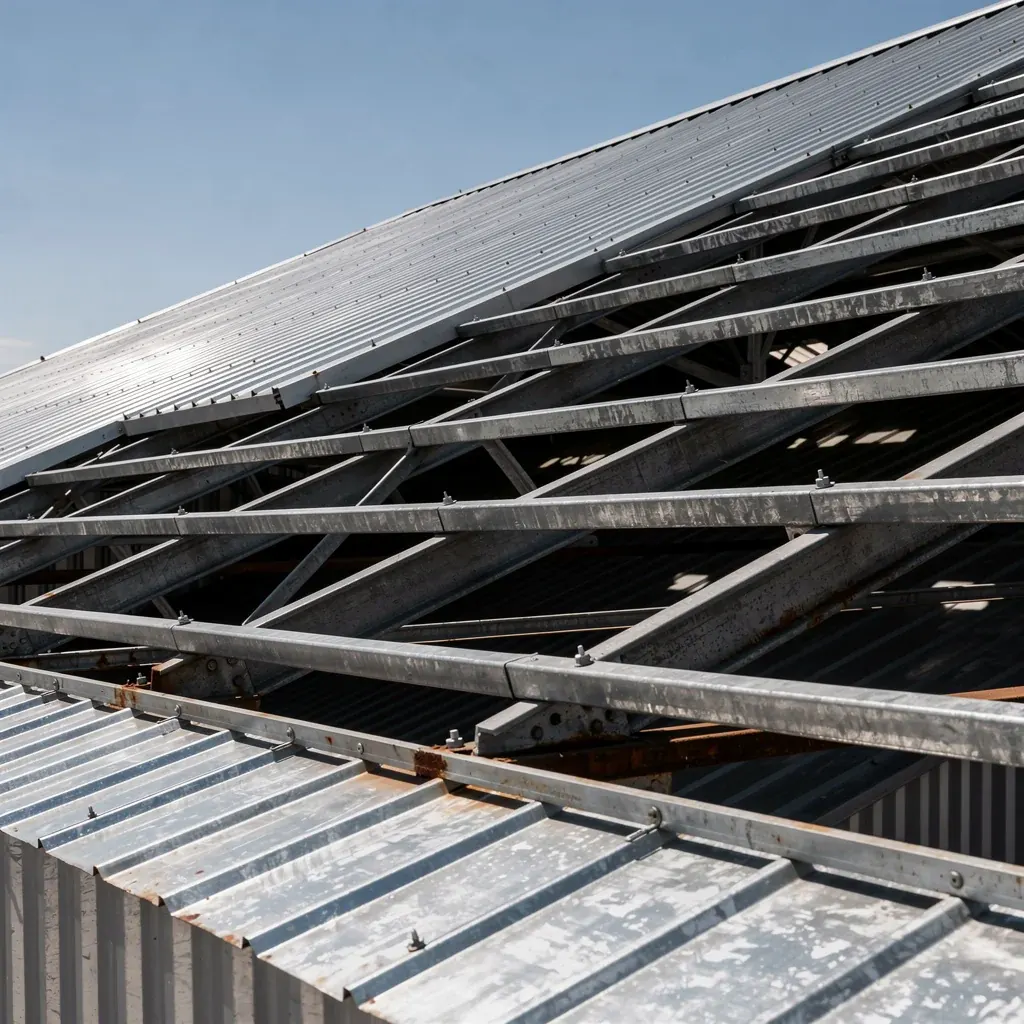
What Is Steel Roof Pitch?
Steel roof pitch describes the slope angle of a steel roof relative to the horizontal plane. It is one of the most important design decisions in any steel building because it directly affects drainage performance, snow load behavior, structural depth, interior clearance, and total project cost. A roof with too shallow a pitch ponds water and leaks prematurely; a roof with too steep a pitch wastes material and increases wind uplift on the windward slope.
Steel roof pitch design must balance climate, roofing material, building use, and span. This guide explains how pitch is defined, what minimum pitch each roofing type requires, how to choose the optimal pitch for your climate, and how pitch interacts with span and cost. For related reading, see our steel structure warehouse design guide.

How Roof Pitch Is Expressed
Roof pitch is expressed in three common ways, and engineers frequently switch between them depending on region and material specification.
1. Degrees
Pitch expressed in degrees measures the angle between the roof surface and the horizontal. A flat roof is 0°, a 45° roof rises as much as it runs. Degrees are used in European practice and in most engineering calculations.
2. Percentage (Slope)
Percentage slope is the rise divided by the run, multiplied by 100. A 10% slope rises 10 units per 100 horizontal units. Percentage is common in civil engineering and is the easiest form for drainage calculations.
3. Rise-Over-Run (Ratio)
Rise-over-run expresses pitch as a ratio such as 1:12 or 4:12. The first number is the rise, the second is the horizontal run (in the same units). This format dominates North American practice.
| Format | Example | Conversion |
|---|---|---|
| Degrees | 9.46° | — |
| Percentage | 16.67% | tan(angle) × 100 |
| Ratio (rise-over-run) | 2:12 | rise / run |
| Ratio (X:12) | Degrees | Percentage |
|---|---|---|
| 1:12 | 4.76° | 8.33% |
| 2:12 | 9.46° | 16.67% |
| 3:12 | 14.04° | 25.00% |
| 4:12 | 18.43° | 33.33% |
| 6:12 | 26.57° | 50.00% |
Minimum Pitch by Roofing Type
Each steel roofing system has a minimum pitch below which water can pool, capillary action can drive water uphill under laps, and warranty coverage is voided. The three most common steel roof systems are corrugated sheets, sandwich panels, and standing seam.
Corrugated Steel Sheet (Minimum 5°)
Corrugated sheets rely on side laps and fasteners to seal against water. At pitches below 5°, wind-driven rain and capillary action can push water past the laps. Corrugated sheet is the most economical roofing but also the most pitch-sensitive. Typical applications: agricultural buildings, low-cost warehouses, workshops.
Sandwich Panel / PU Panel (Minimum 3°)
Sandwich panels combine two steel skins with an insulating core (PU, PIR, or mineral wool). Their deeper profile and tongue-and-groove side joints perform better at low pitches than corrugated sheets. Minimum pitch is typically 3°, though some manufacturers allow 2° for short spans. Sandwich panels are standard for cold storage and insulated warehouses.
Standing Seam (Minimum 1°)
Standing seam roofs use concealed clips and continuous locked seams with no exposed fasteners penetrating the weather surface. This makes them highly watertight and allows pitches as low as 1° (approximately 1:60). Standing seam is the preferred system for large commercial and industrial roofs with low slopes.
| Roofing Type | Minimum Pitch | Typical Use | Relative Cost |
|---|---|---|---|
| Corrugated sheet | 5° (≈1:11) | Agricultural, low-cost | Low |
| Sandwich panel | 3° (≈1:19) | Insulated warehouses, cold storage | Medium |
| Standing seam | 1° (≈1:60) | Large commercial, industrial | High |
| Through-fastened trapezoidal | 4° (≈1:14) | Industrial, retail | Low-Medium |
Optimal Pitch by Climate
Minimum pitch keeps water out, but optimal pitch accounts for climate, particularly snow and rain intensity.
Snow Load Regions
In regions with heavy snowfall (such as Northern China, Canada, Northern Europe, and mountainous regions), a steeper pitch helps snow slide off the roof rather than accumulate. Accumulated snow adds significant live load — often 2-5 kN/m² — and can cause localized failures near valleys and parapets.
- Recommended minimum: 15° (≈3:12) for snow regions
- Optimal: 20-30° for reliable snow shedding
- Caution: above 45°, snow can shed suddenly and dangerously; snow guards may be required
High-Rainfall / Tropical Regions
In tropical and high-rainfall regions, the priority is rapid drainage. Higher rainfall intensity (mm/hour) means gutters and downpipes must work harder, and shallow pitches can be overwhelmed.
- Recommended minimum: 7-10° (≈1.5:12 to 2:12)
- Optimal: 10-15° for fast runoff and reduced ponding risk
- Ensure gutters and downpipes are sized for the catchment area
Hot-Dry Regions
In hot-dry climates (Middle East, North Africa, inland Australia), water drainage is rarely the controlling factor. Pitch can be minimized to reduce roof area exposed to sun and to lower structural cost.
- Recommended: 2-5° (sufficient for occasional rain and cleaning drainage)
- Insulated panels are critical for thermal performance
Wind-Dominated Regions
In cyclone and hurricane zones, steeper pitches increase wind uplift on the windward slope. Optimal pitch balances drainage against wind resistance — typically 5-10° with enhanced edge and ridge fastening.
Pitch vs Span Relationship
Roof pitch and roof span interact structurally. A longer span with the same pitch produces a higher ridge, which increases the surface area exposed to wind and increases the volume of the building envelope.
For portal frame buildings, the slope of the rafter is essentially the roof pitch. Common portal frame slopes are:
- 1:10 (10%) — minimum for drainage, low ridge height, economical
- 1:7 (14.3%) — balanced drainage and snow shedding, very common
- 1:5 (20%) — good for snow regions, higher ridge

Cost Impact of Roof Pitch
Roof pitch affects cost through three main channels: roof area, structural depth, and cladding quantity.
Roof Area and Cladding Quantity
A steeper pitch increases the actual roof surface area for the same plan area. The increase follows the secant of the pitch angle:
| Pitch | Roof Area Multiplier | Additional Cladding |
|---|---|---|
| 1:12 (4.76°) | 1.003 | +0.3% |
| 3:12 (14.04°) | 1.031 | +3.1% |
| 6:12 (26.57°) | 1.118 | +11.8% |
| 12:12 (45°) | 1.414 | +41.4% |
Structural Depth and Ridge Height
A steeper pitch raises the ridge, which can either increase building envelope volume (heating and cooling cost) or require taller columns and perimeter walls. On the positive side, steeper pitches often permit shallower rafters because the slope component helps resist bending — a saving that partially offsets the area increase.
Insulation and Labor
Larger roof area means more insulation, more fasteners, more labor, and longer installation time. Standing seam installation is particularly sensitive to slope changes because the seaming machine must be re-set for each pitch.
Common Steel Roof Pitch Design Mistakes
- Specifying below manufacturer minimum — voids warranty and guarantees leakage
- Ignoring snow load in shallow-pitch design — ponds meltwater and overloads valleys
- Underestimating ponding on long-span flat roofs — deflection feedback can collapse the roof
- Mixing pitch and material without checking compatibility — corrugated sheet at 2° will leak
- Neglecting gutter and downpipe sizing — even the right pitch fails if drainage outlets are too small
- Designing wind uplift only for flat roofs — steeper pitches can have higher windward-slope uplift
- No provision for thermal movement at low pitches — standing seam clips must allow expansion
Pitch Selection Quick Reference
The table below summarizes recommended pitch ranges by building type and climate for fast decision-making:
| Building Type | Mild Climate | Snow Climate | Tropical / High Rain |
|---|---|---|---|
| Warehouse (corrugated) | 5-10° | 10-15° | 10-15° |
| Cold storage (sandwich) | 3-5° | 5-10° | 5-10° |
| Commercial (standing seam) | 1-3° | 5-10° | 3-7° |
| Agricultural (corrugated) | 5-10° | 10-20° | 10-15° |
| Industrial (trapezoidal) | 4-7° | 7-12° | 7-12° |
FAQ
What is the minimum pitch for a steel roof?
It depends on the roofing type. Corrugated steel sheet requires a minimum of 5°, sandwich panels 3°, and standing seam roofs can go as low as 1°. Always confirm the manufacturer's minimum before specifying.
What is the best roof pitch for snow regions?
For reliable snow shedding, a pitch of 20-30° is generally optimal. Below 15°, snow tends to accumulate rather than slide off, which significantly increases live load. Above 45°, snow can shed suddenly and may require snow guards.
How does roof pitch affect cost?
Steeper pitches increase roof surface area (and therefore cladding, insulation, and labor cost). A 6:12 pitch uses about 12% more material than a flat roof over the same plan area. However, steeper pitches can sometimes reduce rafter depth, partially offsetting the increase.
Can I use a flat steel roof?
Truly flat (0°) steel roofs are not recommended because ponding water will eventually penetrate seams. Even "flat" roofs should have at least 1° (≈1:60) of pitch to drain properly, and standing seam is the only common system suitable at that pitch.
What is the relationship between roof pitch and span?
Longer spans with low pitches are more susceptible to ponding instability, where deflection creates a depression that holds water and increases load. For spans over 30 m with pitches below 5°, a formal ponding check is required by AISC 360 and EN 1993-1-3.
Next Steps
Steel roof pitch design is a balancing act between drainage performance, climate demands, structural efficiency, and cost. By choosing a pitch that meets the manufacturer minimum for your roofing type, accounting for snow and rain loads in your region, and verifying ponding performance on long spans, you can deliver a steel roof that performs reliably for decades.
If you need help selecting the right pitch for your steel warehouse, factory, or commercial building, contact our engineering team for a free design consultation and quotation.
Related Articles
Steel Structure Seismic Design: Earthquake-Resistant Guide
Complete guide to earthquake-resistant steel structure design. Learn about seismic codes, ductility design, braced frames, base isolation, and cost
Steel Structure Commercial Buildings: Design & Cost Guide
Complete guide to steel structure commercial buildings. Learn about office buildings, retail centers, shopping malls, hotels, and mixed-use developments
Need a Steel Structure?
Get a free quote from our engineering team. We respond within 2 hours.
Request a QuoteStay Updated
Get steel structure tips, cost guides, and industry insights delivered to your inbox.
No spam. Unsubscribe anytime.