Clear Span Steel Building: Column-Free Warehouse Guide
Complete guide to clear span steel buildings: 30m, 60m, and 100m+ column-free structures. Cost comparison, design considerations, crane integration, and how
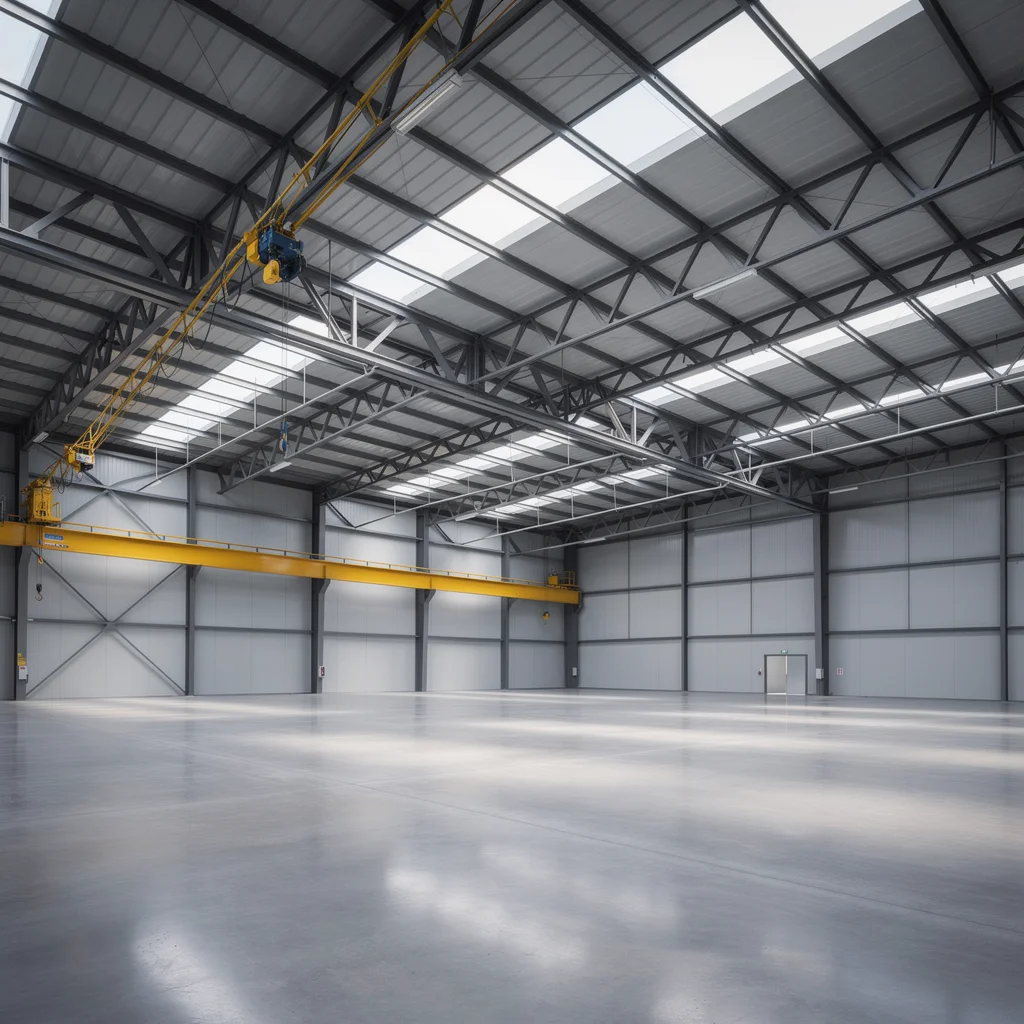
A clear span steel building is a structure with no interior columns — every square meter of floor space is unobstructed from wall to wall. This design is the gold standard for warehouses, aircraft hangars, sports arenas, and industrial facilities where open floor area drives operational efficiency.
If you are planning a steel building and wondering whether clear span is worth the investment, this guide covers everything: how clear span works, cost comparisons across 30m / 60m / 100m spans, design considerations, crane integration, and common mistakes to avoid.
What Is a Clear Span Steel Building?
A clear span steel building (also called a column-free or column-less building) uses a structural system where the roof load is carried entirely by the perimeter columns — no posts, pillars, or columns inside the usable area.
How It Works
The primary structural system is typically a rigid portal frame or space frame:
- Portal frame: Two columns connected by a rafter with moment-resisting connections at the column-to-rafter joint. The frame acts as a single structural unit.
- Space frame (truss): A triangulated 3D framework of steel tubes or sections. Used for spans exceeding 60m or non-rectangular layouts.
Key Components
| Component | Function in Clear Span |
|---|---|
| Columns | Support the roof at the perimeter. Typically H-section or box section |
| Rafters / Trusses | Span horizontally between columns. Built-up plate girders or trusses for longer spans |
| Knee bracing / Haunches | Deepened section at column-rafter junction to resist high moment forces |
| Purlins | Secondary roof members spanning between rafters — support roof cladding |
| Girts | Secondary wall members between columns — support wall cladding |
| Bracing (wind / roof) | Diagonal members that provide lateral stability to the frame |
| Base plates | Steel plates at column feet — anchor the structure to the foundation |
Clear Span vs Multi-Span
| Factor | Clear Span | Multi-Span (with columns) |
|---|---|---|
| Interior columns | None | One row every 15–30m |
| Usable floor space | 100% unobstructed | 85–95% (columns take up space) |
| Steel weight | 30–50 kg/m² | 22–35 kg/m² |
| Relative cost | Baseline +20–35% | Baseline |
| Maximum width | Up to 120m (space frame) | Unlimited |
| Best for | Warehouses, hangars, arenas | Factories, workshops, multi-bay facilities |
Clear Span by the Numbers: 30m, 60m, and 100m
30m Clear Span (Typical Warehouse)
The 30m clear span is the most common size in the market. It balances cost-effectiveness with generous open space.
| Specification | Typical Value |
|---|---|
| Structural system | Portal frame (rigid) |
| Column size | H350–450 × 200–250 mm |
| Rafter size | H500–700 × 200–250 mm |
| Eave height | 8–12 m |
| Steel weight | 28–35 kg/m² |
| Columns required | 2 (one each side) |
| Cost premium vs multi-span | +15–20% |
60m Clear Span (Large Industrial)
A 60m clear span is a major structural achievement. It requires heavier sections and deeper foundations.
| Specification | Typical Value |
|---|---|
| Structural system | Heavy portal frame or truss |
| Column size | H500–800 × 300–400 mm |
| Rafter / Truss depth | 1.5–3.0 m |
| Eave height | 10–15 m |
| Steel weight | 42–55 kg/m² |
| Columns required | 2 (one each side) |
| Cost premium vs multi-span | +30–45% |
100m+ Clear Span (Ultra-Large)
At 100m and beyond, a standard portal frame is no longer economical. The industry standard for ultra-long spans is a space frame or steel truss system.
| Specification | Typical Value |
|---|---|
| Structural system | Space frame or long-span truss |
| Steel grade | Q355B or higher (Q420, S355) |
| Truss depth | 3–6 m |
| Eave height | 12–20 m |
| Steel weight | 55–80 kg/m² |
| Columns required | 2 (or none with arch design) |
| Cost premium vs multi-span | +50–80% |
Cost Analysis: Clear Span Steel Building Pricing
Clear span buildings cost more per square meter than multi-span designs because each column pair must carry the entire roof load over a greater distance. Here is a realistic pricing guide:
FOB Prices (Steel Structure Only, 2026)
| Building Configuration | FOB Price (USD/m²) | Steel Weight (kg/m²) | |----------------------|:------------------:|:-------------------:| | 20–30m clear span, no crane | $30–45 | 28–35 | | 30–40m clear span, no crane | $38–55 | 32–40 | | 30–40m clear span with 10T crane | $48–70 | 40–50 | | 50–60m clear span, no crane | $55–80 | 42–55 | | 50–60m clear span with 20T crane | $70–100 | 55–70 | | 100m+ space frame, no crane | $80–140 | 55–80 |
*Prices are FOB (Free On Board) from a Chinese manufacturer. Ocean freight, import duties, foundation, and installation are additional.*
Cost Comparison: Clear Span vs Multi-Span Example
Project: 5,000m² logistics center, 40m width × 125m length
| Option | Configuration | Steel Weight | Fabrication Cost | Foundation Cost | Total Structure Cost | |--------|--------------|:------------:|:----------------:|:---------------:|:-------------------:| | Clear span (40m × 125m) | Single span, no columns | 42 kg/m² | $55/m² | $12/m² | $67/m² → $335,000 | | Multi-span (20m + 20m) | 2 spans, 1 column row | 30 kg/m² | $35/m² | $10/m² | $45/m² → $225,000 |
The clear span option costs 49% more ($110,000) but provides unobstructed floor space. The question is whether the operational value of column-free space exceeds that premium.
When Clear Span Makes Financial Sense
Clear span steel buildings are worth the premium when:
1. High-Density Pallet Racking
Automated or high-bay racking systems leave no room for columns. A 30m-40m clear span can fit racking layouts with zero dead zones:
- 10m building with columns: 8–12% floor space lost to columns and rack offsets
- 10m clear span building: 0% floor space lost — full racking coverage
2. Forklift and Equipment Movement
Forklifts, reach trucks, and AGVs (automated guided vehicles) need clear paths. Interior columns create blind spots, reduce turning radii, and slow operations.
3. Future Layout Flexibility
Business requirements change. A clear span building allows you to reconfigure racking, add mezzanines, or change from storage to light manufacturing without fighting columns.
4. Aircraft and Vehicle Hangars
Aircraft, buses, and large vehicles need unobstructed space. A single column can render an entire hangar bay unusable for certain aircraft types.
Design Considerations for Clear Span Buildings
Column Size and Foundation
Clear span columns experience higher bending moments (especially at the base) than multi-span columns. This means:
| Span | Column Section | Base Plate Size | Foundation Size | |------|---------------|:---------------:|:---------------:| | 20–30m | H350–450 | 450 × 450 × 25mm | 1.5m × 1.5m × 0.5m | | 30–45m | H400–600 | 550 × 550 × 30mm | 2.0m × 2.0m × 0.6m | | 45–60m | H500–800 | 650 × 650 × 35mm | 2.5m × 2.5m × 0.7m |
Foundation depth and reinforcement must be designed by a structural engineer to account for the cantilever effect of the clear span frame.
Roof Deflection
Long-span roofs deflect more under load. Design limits:
| Structural Element | Deflection Limit | Notes | |-------------------|:----------------:|-------| | Roof rafters (live load) | L/240 to L/360 | Standard occupied buildings | | Roof rafters (snow load) | L/240 | Snow regions | | Crane beams | L/600 to L/1000 | Depends on crane duty class | | Cantilevers | L/180 | Eave overhangs |
For a 40m clear span, L/240 means maximum deflection of 167mm. This is safe for most building uses, but you should inform your cladding supplier so they can accommodate movement at panel joints.
Crane Integration in Clear Span Buildings
Clear span buildings can accommodate overhead cranes — but the design differs from multi-span buildings:
| Crane Type | Integration Method | Building Impact |
|---|---|---|
| Underhung crane | Runs on bottom flange of roof rafters | Lighter crane (≤10T), no extra columns needed |
| Top-running crane | Crane beams supported by columns | Heavier crane (10–50T), columns serve dual purpose |
| Free-standing gantry | Independent columns for crane runway | No load on building frame, separate foundation |
- Increased column bending from crane vertical + horizontal loads
- Stiffer column sections to limit crane beam deflection
- Crane surge (longitudinal braking forces) transferred to bracing system
- Fatigue at the column-to-base connection (high number of crane cycles)
Thermal Expansion
Clear span buildings are longer than they are wide. The long direction (typically 60–200m) can experience significant thermal expansion:
| Temperature Range | Expansion (per 100m of steel) | |:----------------:|:----------------------------:| | ±20°C | ±24mm | | ±40°C | ±48mm | | ±60°C | ±72mm |
Steel expands at approximately 0.012mm per meter per °C. For a 125m-long clear span building in a climate with 50°C seasonal variation, total expansion is 75mm. Slotted connections at one end of the building accommodate this movement — a detail that many first-time buyers miss.
Common Mistakes in Clear Span Steel Building Design
Mistake 1: Over-Estimating the Span-Cost Curve
Many buyers assume that because 30m clear span costs 20% more than multi-span, 60m will cost 40% more. In reality, the cost curve is exponential above 40m. A 60m clear span can cost 45–60% more than a multi-span equivalent — plus the foundation costs increase significantly.
Fix: Be realistic about your span requirement. If you need 60m width but 30m would work with careful racking layout, the savings may justify a narrower building.
Mistake 2: Ignoring Foundation Costs
Clear span buildings produce larger overturning moments at column bases. This often means larger, deeper, and more reinforced foundations — especially in poor soil. A $10/m² increase in fabrication cost can come with a $5–8/m² increase in foundation cost.
Fix: Get a foundation design from your steel supplier before finalizing the budget. Laotie Steel includes foundation loads and recommended foundation designs with every quotation.
Mistake 3: Inadequate Bracing for Wind Load
Clear span buildings have no interior frames to help resist lateral loads. All wind load must be carried by the end walls and roof bracing. In high-wind regions (cyclone zones, typhoon regions), this requires significantly heavier bracing than a multi-span building.
Fix: Provide accurate wind load data to your designer. Wind speed, exposure category, and terrain type all affect the bracing design.
Mistake 4: Forgetting About Deflection
The longer the span, the more the roof deflects. Excessive deflection can cause:
- Ponding of rainwater on flat or low-slope roofs
- Cladding panels pulling apart at joints
- Doors and windows jamming in their frames
- Perception of "bounciness" for occupants
Mistake 5: Not Planning for Future Crane Installation
Adding a crane to an existing clear span building is difficult and expensive — often requiring strengthening of every column and foundation. If there is even a 20% chance you will need a crane, design for it from the start.
Fix: Design columns and foundations for "future crane" even if you don't install the crane now. The incremental cost is usually 5–10% — far less than retrofitting.
Clear Span Steel Building Applications
Clear span structures are used across a wide range of industries:
Warehouses and Distribution Centers
Column-free space maximizes pallet racking density and allows efficient forklift movement. Clear span warehouses typically achieve 10–15% higher storage density than multi-span equivalents.Aircraft Hangars
A Boeing 737 has a wingspan of 35m, an Airbus A380 spans 80m. Clear span hangars accommodate these dimensions without column obstructions that could damage wings during maneuvering.Sports Facilities
Indoor sports halls, basketball arenas, and tennis centers require unobstructed space for play. Clear span designs up to 60m are standard for multi-court facilities.Agricultural Buildings
Poultry sheds, grain storage, and equipment barns benefit from column-free space for equipment movement and flexible pen layouts.Manufacturing Facilities
Production lines, assembly areas, and heavy fabrication shops need uninterrupted floor space for equipment layouts and workflow optimization.Case Study: 40m Clear Span Warehouse
Project: 3,600m² warehouse for a logistics company in Manila, Philippines Configuration: 40m clear span × 90m length × 12m eave height Structural system: Rigid portal frame, Q355B steel Crane: None (racking-only facility) Cladding: PIR insulated sandwich panels (roof and walls)
Cost Breakdown
| Item | Cost (USD) | |------|:----------:| | Steel fabrication (FOB China) | $59,400 ($16.50/m²) | | Cladding and accessories | $36,000 ($10.00/m²) | | Ocean freight (Manila) | $5,400 (3×40HQ containers) | | Import duties and clearance | $5,500 (~5% duty) | | Foundation (good soil, spread footings) | $21,600 ($6.00/m²) | | Local installation | $25,200 ($7.00/m²) | | Total project cost | $153,100 ($42.50/m²) |
Timeline
| Phase | Duration | |-------|:--------:| | Design and drawing approval | 10 days | | Fabrication | 25 days | | Shipping (Shanghai to Manila) | 12 days | | Customs clearance | 5 days | | Foundation (site work concurrently with fabrication) | 21 days | | Erection | 18 days | | Total (coordination overlap) | ~65 days |
The client reported that the clear span design allowed 20% more racking positions compared to their previous multi-span warehouse of the same footprint.
How to Specify Your Clear Span Steel Building
When requesting a quotation from a steel structure manufacturer, provide:
- Building dimensions: Width (clear span), length, and eave height in meters
- Clear span requirement: Confirm column-free interior
- Design loads: Wind speed (m/s or km/h), snow load (kN/m²), seismic zone
- Roof slope: Typically 5–10% for drainage
- Cladding type: Single-skin, sandwich panel (specify insulation thickness if needed)
- Crane requirements: Capacity (tons), span, duty class (if any)
- Doors and accessories: Quantity, size, type of doors
- Destination port: For freight calculation
- Local building code: IBC, Eurocode, AS/NZS, or country-specific
Why Choose Laotie Steel for Your Clear Span Building?
Laotie Steel Structure Co., Ltd. has been fabricating and exporting clear span steel buildings since 2009. Here is what sets us apart:
- 5 production lines with 60,000 tons annual capacity
- CE (EN 1090) & ISO 9001 certified — international quality standards
- In-house engineering team using Tekla Structures for 3D modeling
- 200+ clear span projects completed in 30+ countries
- Full design support — shop drawings, erection drawings, foundation loads
- Factory-direct pricing — save 30–50% vs local fabrication
Frequently Asked Questions
Q: What is the maximum clear span for a steel building? A: For portal frame structures, practical maximum is around 60m. For space frame or truss systems, clear spans of 120m+ are achievable. The record for a clear span steel structure exceeds 200m (Beijing National Stadium, "Bird's Nest").
Q: Is clear span more expensive than multi-span? A: Yes — typically 20–50% more for the steel structure alone, depending on span length. However, when you account for the increased usable space, faster erection, and flexibility, the total cost of ownership can be comparable or lower.
Q: Can I add a crane to an existing clear span building? A: Possible but expensive. Retrofitting requires strengthening columns, foundations, and often the roof structure. It is much more cost-effective to design for a future crane from the beginning.
Q: What is the minimum roof slope for a clear span building? A: For drainage, minimum 5% (1:20) for standard roof cladding. Low-slope designs (1–3%) require standing seam metal roofing with sealed joints.
Q: How long does a clear span steel building last? A: 50+ years with proper maintenance. The coating system is the largest determinant of service life — a high-build epoxy system in a moderate climate lasts 20+ years before requiring repainting.
Q: Can clear span buildings be extended later? A: Yes — the end wall can be removed and the frame extended with additional bays. This is one of the key advantages of steel structures over concrete.
Get Your Clear Span Steel Building Quote
Ready to build a column-free warehouse, hangar, or industrial facility? Laotie Steel Structure provides complete design, fabrication, and shipping for clear span steel buildings worldwide.
📱 WhatsApp: +86 166-5073-5555 🌐 Website: https://www.laotie-steel.com 📧 Contact: Use the website contact form or reach us directly on WhatsApp
Send us your project requirements and get a detailed quotation within 24 hours.
Related Articles
Steel Structure Seismic Design: Earthquake-Resistant Guide
Complete guide to earthquake-resistant steel structure design. Learn about seismic codes, ductility design, braced frames, base isolation, and cost
Steel Structure Commercial Buildings: Design & Cost Guide
Complete guide to steel structure commercial buildings. Learn about office buildings, retail centers, shopping malls, hotels, and mixed-use developments
Need a Steel Structure?
Get a free quote from our engineering team. We respond within 2 hours.
Request a QuoteStay Updated
Get steel structure tips, cost guides, and industry insights delivered to your inbox.
No spam. Unsubscribe anytime.