Bolted vs Welded Connections in Steel Structures
Compare bolted vs welded connections in steel structures. Learn bolt grades, weld types, design strength, erection speed, cost, and when to use each
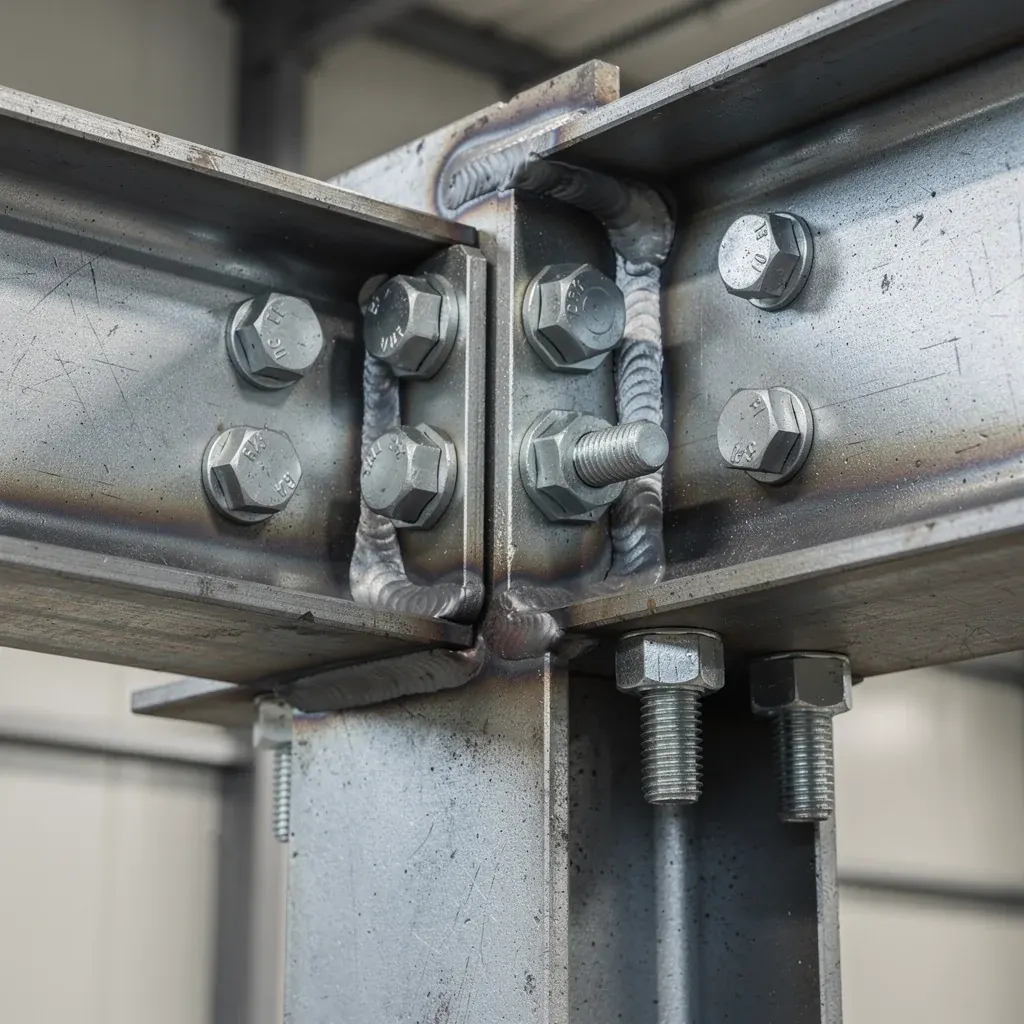
Why Connections Define the Performance of a Steel Structure
In any steel structure, members carry the load — but connections transfer it. A poorly designed or executed connection is the most common root cause of structural failures, from beam-to-column joints to base plates and truss nodes. The choice between bolted and welded connections affects not only structural strength and stiffness, but also fabrication cost, erection speed, inspection burden, and future maintainability.
This guide compares bolted and welded connections across every dimension that matters to a designer, fabricator, or owner: types, bolt grades, weld categories, design strength, erection speed, cost, inspection, and selection criteria.

Bolted Connections: Types and Behavior
Bolts are the dominant connection method in modern steel construction because they are fast to install, easy to inspect, and allow disassembly. Design codes (AISC 360, Eurocode 3, GB 50017) classify bolted joints by load-transfer mechanism.
Bearing-Type Connections
In a bearing-type joint, bolts are installed snug-tight and load is transferred through bolt shank bearing against the plate hole. The bolt is in shear, the plate is in bearing. This is the simplest and most economical bolted connection.
- Typical application: secondary beams, bracing, lightly loaded joints
- Installation effort: low (snug-tight with impact wrench)
- Slip under service load: permitted (design accounts for it)
Slip-Critical (Friction-Type) Connections
Slip-critical joints transfer load through friction between faying surfaces, generated by clamping force from pretensioned bolts. No slip occurs under service load, making them essential for fatigue, seismic, and vibration-sensitive structures.
- Typical application: bridge girders, crane runways, seismic moment connections
- Surface preparation: blast-cleaned bare steel or Class A/B slip coefficient
- Installation effort: high (torque control, turn-of-nut, or direct tension indicator)
Pretensioned Bolts
Required by AISC for seismic, fatigue, and slip-critical applications. Pretension is achieved by:
- Turn-of-nut method (rotation after snug-tight)
- Calibrated wrench (torque control)
- Direct Tension Indicator (DTI) washers
- Twist-off-type tension-control bolts (TC bolts)
Bolt Grades and Mechanical Properties
Selecting the right bolt grade is critical. Higher grades carry more load but are more brittle and sensitive to installation quality.
| Standard | Grade | Tensile Strength (MPa) | Yield Strength (MPa) | Typical Use |
|---|---|---|---|---|
| ISO 898 / GB | 4.6 | 400 | 240 | Secondary structures, light duty |
| ISO 898 / GB | 4.8 | 400 | 320 | General purpose |
| ISO 898 / GB | 5.6 | 500 | 300 | Ductility-critical joints |
| ISO 898 / GB | 8.8 | 800 | 640 | Primary members, slip-critical |
| ISO 898 / GB | 10.9 | 1000 | 900 | High-strength primary connections |
| ASTM | A325 | 827 (≤1" dia) | 635 | Equivalent to 8.8, US standard |
| ASTM | A490 | 1040 | 940 | Equivalent to 10.9, heavy structural |
| EN | HV 10.9 | 1000 | 900 | European high-strength, EN 14399 |
Welded Connections: Types and Applications
Welding produces a monolithic, full-strength joint with no holes, no slip, and no additional hardware. It is the default choice for shop fabrication, rigid moment connections, and fatigue-critical joints.
Fillet Welds
The most common weld type, depositing a triangular cross-section between two surfaces at 90° or other angles. Simple to execute, no special edge preparation, but lower efficiency than groove welds.
- Effective throat = 0.707 × leg size
- Minimum leg size governed by the thinner connected part
- Typical size range: 3–12 mm
Butt (Groove) Welds
Full-penetration groove welds develop the full strength of the connected parts, making them the choice for primary tension members, moment flanges, and column splices.
- Require bevel, V, or J groove preparation
- Backing bar or back-gouging for full penetration
- Higher cost and inspection burden (UT or RT required)
Plug and Slot Welds
Used to transmit shear in lap joints or to prevent buckling of cover plates. Limited in fatigue applications and not permitted in primary tension members.

Design Strength Comparison: Bolts vs Welds
The table compares nominal shear and tension strength for a typical single-shear lap joint connecting two 12 mm thick plates with one M20 bolt or a 6 mm fillet weld per side.
| Connection | Detail | Shear Capacity (kN) | Tension Capacity (kN) | Stiffness |
|---|---|---|---|---|
| Bolt 8.8 M20 (bearing) | Single shear, threads excluded | 88 | 141 | Medium (slip at service) |
| Bolt 10.9 M20 (slip-critical) | Class A surface, preloaded | 69 (slip) / 110 (ultimate) | 157 | High (no slip) |
| Fillet weld 6 mm | 50 mm length each side | 134 | — | High (monolithic) |
| Full-penetration butt weld | Matching filler, BM strength | 245 (plate-governed) | 245 (plate-governed) | Highest (full BM) |
Erection Speed: Field Reality
Speed of erection often governs connection selection, especially for large projects with tight schedules.
| Factor | Bolted (Bearing) | Bolted (Slip-Critical) | Welded (Field) |
|---|---|---|---|
| Shop fabrication | Holes + bolting | Holes + surface prep | Weld prep + welding |
| Field installation per joint | 5–15 min | 15–30 min | 30–90 min |
| Weather sensitivity | Low | Low (if dry) | High (wind, rain, temperature) |
| Crew skill | Medium | High | Very high (certified welders) |
| Best for | Fast-track, modular | Bridges, seismic | Shop fabrication, rigid frames |
Cost Comparison
Cost is more than material price — it includes fabrication labor, field labor, inspection, and touch-up.
| Cost Component | Bolted (Bearing) | Bolted (Slip-Critical) | Welded (Shop) | Welded (Field) | ----------------|------------------|------------------------|---------------|----------------| | Material (bolts vs consumables) | Low | Medium | Lowest | Lowest | | Shop labor (per joint) | USD 8–15 | USD 15–25 | USD 10–20 | — | | Field labor (per joint) | USD 5–12 | USD 12–25 | — | USD 25–60 | | Inspection | Visual only | Visual + torque audit | Visual + MT | UT/RT 10–100% | | Surface treatment | Standard | Special Class A/B | Standard | Standard + touch-up | | Total cost index | 1.0 (baseline) | 1.6–2.0 | 1.2–1.5 | 2.5–3.5 |
Practical tip: Hybrid connections — shop-welded, field-bolted — are the most economical solution for the vast majority of buildings. Fabricate rigid sub-assemblies in the shop, ship them, and bolt them together on site.
To understand the upstream fabrication processes that make these connections possible, read: Steel Structure Processing Techniques: CNC and Welding Guide.
Inspection and Quality Control
Inspection rigor scales with consequence of failure.
Bolted Joints
- Visual inspection of all bolts (100%)
- Torque audit on 10% of pretensioned bolts (minimum 2 per joint)
- DTI verification for slip-critical joints
- Ultrasonic inspection of A490 bolts > 25 mm diameter (per RCSC)
Welded Joints
- Visual inspection (VT) — 100% of all welds
- Magnetic particle (MT) or dye penetrant (PT) — surface cracks on critical welds
- Ultrasonic testing (UT) — full-penetration groove welds in seismic and fatigue applications
- Radiographic testing (RT) — selected welds, typically 5–10%
- Welder qualification (WPS, PQR) and continuous inspection for high-seismic structures

When to Use Each: A Decision Framework
| Situation | Recommended Connection | Reason |
|---|---|---|
| Fast-track warehouse, secondary beams | Bolted bearing | Fast, low skill, low cost |
| Bridge, fatigue, dynamic load | Slip-critical bolts or full-pen weld | No slip, predictable behavior |
| Seismic moment frame | Shop-welded + field-bolted hybrid | Rigid joints, controlled quality |
| Column splice in tall building | Full-pen butt weld or slip-critical bolts | Full member strength, ductile |
| Field connection in cold/wet climate | Slip-critical bolts | Welding weather-dependent |
| Architectural exposed structure (clean look) | Welded, ground smooth | No bolt heads, aesthetic |
| Modular, relocatable structure | Bolted bearing | Disassembly possible |
| Tubular truss node | Welded | Geometry, no bolt access |
Design Detailing Rules of Thumb
A few practical rules separate good connections from bad ones:
- Minimum bolt spacing: 3× bolt diameter (center-to-center) per AISC / EC3
- Edge distance: ≥ 1.25× bolt diameter for standard holes, more for oversized
- Net section check: bearing connections must check plate net area at the bolt hole line
- Weld returns: fillet welds should wrap around corners by 2× leg size to reduce stress concentration
- Access for tightening: leave minimum 60 mm clearance for impact wrench operation
- Galvanizing vent/drain: sealed tubular sections with welded end plates require vent holes for HDG
FAQ
Q1: Are bolts stronger than welds? No — a properly designed full-penetration butt weld develops the full strength of the connected base metal, while bolts always introduce a reduced net section and hole-affected capacity. However, bolted joints can be designed to meet any required strength, and they are easier to inspect, install, and replace in the field.
Q2: Can I mix bolts and welds in the same connection? Generally, no. Mixing welds and bolts in the same load path is discouraged by AISC and EC3 because the weld (stiffer) attracts most of the load and the bolts contribute little. The exception is shop-welded / field-bolted hybrid connections where each interface transfers load independently.
Q3: What is the difference between A325 and A490 bolts? A325 (≈ 8.8) has a tensile strength of ~827 MPa and is the standard structural bolt in the US. A490 (≈ 10.9) has ~1040 MPa tensile strength and is used for high-strength, heavy structural connections. A490 bolts are more brittle, cannot be galvanized, and require stricter installation control.
Q4: How do I specify a slip-critical connection correctly? Specify four things: (1) bolt grade and diameter, (2) pretensioning method (turn-of-nut, DTI, or TC bolt), (3) faying surface class (Class A, B, or C with corresponding slip coefficient), and (4) the design slip resistance per code. The fabricator must protect the faying surface from paint, oil, and rust before final bolting.
Q5: Why are field welds more expensive than shop welds? Field welding requires certified welders, weather protection, equipment transport, scaffolding, and 100% more inspection. Productivity is 30–50% lower than shop welding due to position and access constraints. That is why hybrid shop-welded / field-bolted structures dominate modern construction.
Next Steps
Connection design is where structural engineering meets fabrication reality. Specify the right connection type for each joint — bolted for speed and field flexibility, welded for stiffness and monolithic behavior, hybrid for the best of both — and your structure will be stronger, faster, and cheaper to build.
If you need a fabrication partner with certified welders (AWS D1.1, EN 1090, ISO 3834), WPS/PQR documentation, and full UT/RT inspection capability for bolted and welded connections alike, our engineering team is ready to help.
Contact our connection engineering specialists today to discuss your project requirements and get a detailed fabrication quote.
Related Articles
Steel Structure Engineering: Design to Construction Workflow
Complete guide to steel structure engineering workflow. Learn each phase from design analysis and connection detailing to fabrication, shipping, and on-site
Crane Beam Design Guide: Steel Structure Loads, Span & Cost
Complete guide to crane beam design for steel structures. Learn overhead crane types, wheel load calculation, span design, connection details, and cost factors.
Need a Steel Structure?
Get a free quote from our engineering team. We respond within 2 hours.
Request a QuoteStay Updated
Get steel structure tips, cost guides, and industry insights delivered to your inbox.
No spam. Unsubscribe anytime.