Pre-Engineered Building: Complete Specs & Standards Guide
Learn PEB specifications, MBMA/AISC standards, steel grades, coating systems, and design parameters for pre-engineered buildings. Compare PEB vs
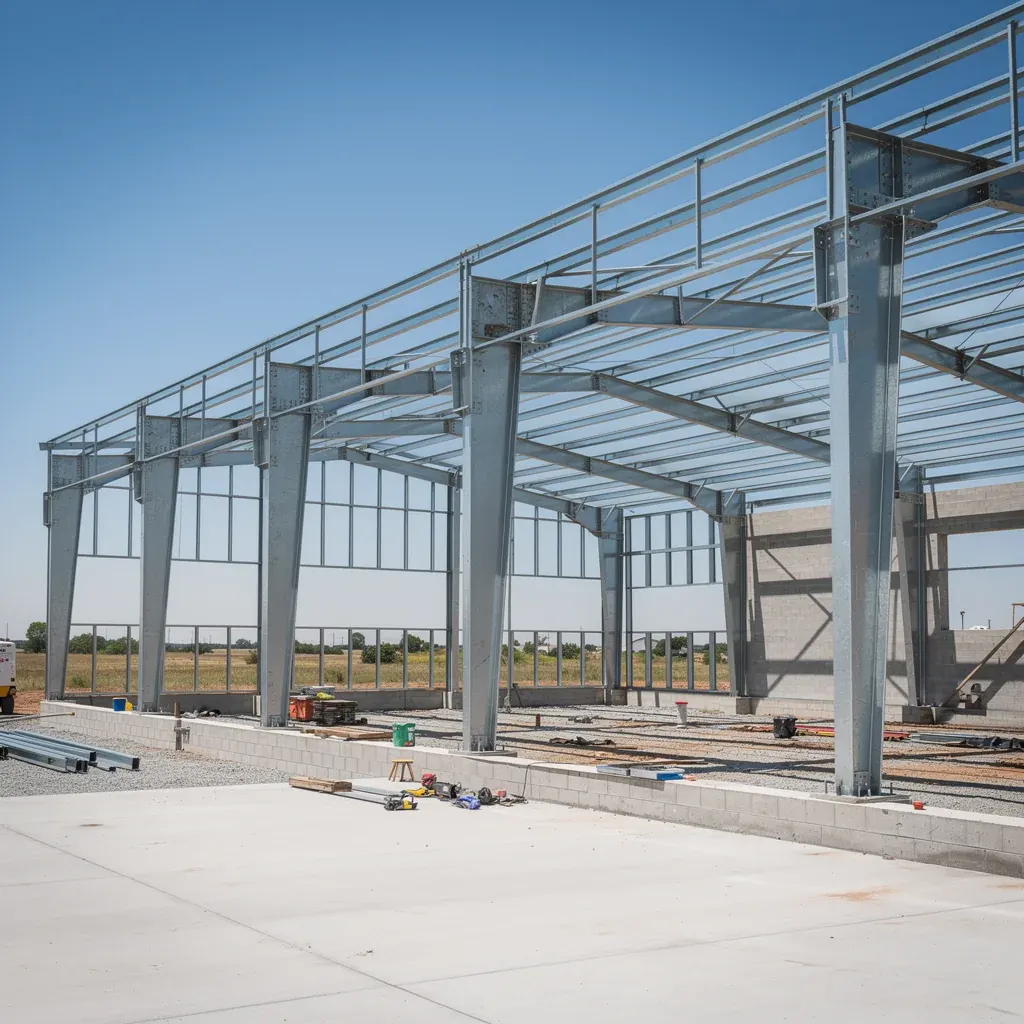
Pre-engineered buildings (PEB) have transformed the construction industry by delivering factory-fabricated steel structures that are faster, cheaper, and more consistent than conventional construction. But the success of a PEB project depends entirely on whether the specifications and standards are clearly defined and correctly executed.
This buyer guide covers everything you need to know about pre-engineered building specifications — from industry standards and main components to design parameters, steel grades, coating systems, and fabrication tolerances.
PEB vs Conventional Steel Construction
Before diving into specifications, it is important to understand how PEB differs from conventional steel construction.
| Factor | Pre-Engineered Building (PEB) | Conventional Steel |
|---|---|---|
| Design method | Pre-engineered, optimized sections | Custom-engineered per project |
| Fabrication | Factory-standardized, mass-produced | Fabricated on-site or in small batches |
| Delivery time | 6–10 weeks | 16–24 weeks |
| Steel usage | Optimized (tapered sections) | Higher (uniform sections) |
| Foundation cost | Lower (lighter structure) | Higher |
| Flexibility | Limited to standard configurations | Full design freedom |
| Quality consistency | High (factory-controlled) | Variable |
| Best for | Warehouses, factories, hangars, gyms | Complex or architecturally unique buildings |
When to Choose PEB
PEB is the ideal choice when your project involves:
- Standard rectangular or L-shaped buildings
- Clear spans up to 100 meters
- Fast-track construction schedules
- Budget-sensitive industrial or commercial projects
- Repeat building types (franchise stores, distribution centers)
Key PEB Standards and Codes
Pre-engineered buildings are governed by a framework of international standards. Specifying the correct standard in your contract ensures the building meets the required safety and performance level.
MBMA (Metal Building Manufacturers Association)
MBMA is the primary standard for PEB in North America. It covers:
- Load combinations for metal building systems
- Crane load requirements
- Roof and wall panel performance criteria
- Secondary framing (purlins and girts) design
- Tolerance standards for fabrication and erection
AISC 360 (American Institute of Steel Construction)
AISC 360 governs the structural design of steel buildings, including:
- Load and Resistance Factor Design (LRFD) method
- Allowable Strength Design (ASD) method
- Connection design requirements
- Welding and bolting specifications
- Seismic design provisions (AISC 341)
AISI (American Iron and Steel Institute)
AISI standards apply to cold-formed steel members used in PEB secondary framing:
- AISI S100: North American Specification for Cold-Formed Steel Structural Members
- AISI S200: General Provisions for Cold-Formed Steel Framing
Other Regional Standards
| Region | Primary Standard | Scope |
|---|---|---|
| North America | MBMA + AISC 360 + AISI | PEB systems, structural design, cold-formed |
| Europe | Eurocode 3 (EN 1993) | Steel structures design |
| China | GB 50017 + GB 50018 | Hot-rolled and cold-formed steel |
| Australia | AS 4100 + AS/NZS 4600 | Steel structures and cold-formed |
| India | IS 800 + IS 801 | Steel design and cold-formed |
Main PEB Components
A pre-engineered building consists of several integrated components, each engineered to work together as a system.
Rigid Frames (Primary Framing)
The rigid frame is the main load-bearing structure of a PEB. It typically consists of:
- Columns: Vertical members supporting the roof and transferring loads to the foundation
- Rafters: Inclined beams spanning between columns
- Connection: Moment-resisting connections at the eave and peak
| Frame Type | Span Range | Best For |
|---|---|---|
| Tapered column and rafter | 15–60 m | Most PEB warehouses and factories |
| Straight column and rafter | 15–30 m | Office buildings, mezzanine floors |
| Single slope | 10–30 m | Extensions, lean-to structures |
| Multi-span (continuous) | 30–100 m | Large distribution centers |
Purlins (Secondary Roof Framing)
Purlins span between rafters and support the roof panels. They are typically cold-formed Z-sections or C-sections.
- Z-section purlins: Most common — allows nesting and continuous span optimization
- C-section purlins: Used at edges and openings
- Standard depth: 150–300 mm
- Thickness: 1.5–3.0 mm (pre-galvanized)
Girts (Secondary Wall Framing)
Girts span between columns and support wall panels. They are similar to purlins but installed vertically on walls.
- Bypass girts: Mounted on the outside of columns (most common)
- Inset girts: Mounted between columns (flush wall)
- Flush girts: Mounted flush with column outer face
Roof and Wall Panels
Panels provide weather enclosure and contribute to the building's structural diaphragm action.
- Corrugated panels: Single-skin, economical, for un-insulated buildings
- Standing seam panels: Concealed fasteners, weather-tight, allows thermal movement
- Insulated sandwich panels: Foam core (EPS, PU, rockwool) for thermal insulation
- Profile depth: Typically 25–40 mm for roof, 15–25 mm for wall

Design Parameters
PEB design parameters must be clearly specified in the contract to ensure the building meets local conditions and performance requirements.
Wind Load
Wind load is often the governing lateral load for PEB structures. Key parameters:
- Basic wind speed (3-second gust): Per ASCE 7 or local code (e.g., 150 km/h for coastal Florida, 100 km/h for inland China)
- Exposure category: B (urban), C (open terrain), D (coastal)
- Building importance factor: 1.0 (standard), 1.15 (essential facilities)
- Internal pressure coefficient: Depends on opening ratio (enclosed, partially enclosed, open)
Snow Load
Snow load governs roof design in cold climates. Key parameters:
- Ground snow load: Per ASCE 7 or local code (e.g., 2.4 kN/m² for northern US, 0.5 kN/m² for southern China)
- Roof slope factor: Reduces load on steep roofs
- Exposure factor: Accounts for wind exposure
- Thermal factor: Accounts for roof heat loss
Seismic Load
Seismic design is critical in earthquake zones. Key parameters:
- Seismic design category: Per ASCE 7 or local code (A through F)
- Spectral response acceleration: Ss and S1 values for the site
- Site class: A (hard rock) through F (soft soil)
- Response modification coefficient (R): 3.5–8 for steel braced frames
| Design Parameter | Typical Range | Governing Code |
|---|---|---|
| Wind speed | 90–200 km/h | ASCE 7 / IS 875 / GB 50009 |
| Snow load | 0.5–5.0 kN/m² | ASCE 7 / GB 50009 |
| Seismic category | A–F | ASCE 7 / GB 50011 |
| Live load (roof) | 0.5–1.0 kN/m² | ASCE 7 / GB 50009 |
| Dead load (roof) | 0.2–0.5 kN/m² | Calculated |
Steel Grades for PEB
Selecting the correct steel grade is critical for both performance and cost. PEB manufacturers typically offer several grades depending on the project requirements.
Common Steel Grades
| Standard | Grade | Yield Strength (MPa) | Common Application |
|---|---|---|---|
| GB (China) | Q235B | 235 | Secondary framing, light panels |
| GB (China) | Q355B | 355 | Primary framing, rigid frames |
| ASTM (US) | A36 | 250 | General structural, plates |
| ASTM (US) | A572 Gr.50 | 345 | Primary framing, high-strength |
| ASTM (US) | A992 | 345 | W-shapes for columns and rafters |
| EN (Europe) | S235JR | 235 | Secondary framing |
| EN (Europe) | S355JR | 355 | Primary framing |
| JIS (Japan) | SS400 | 245 | General structural |
| JIS (Japan) | SM490 | 325 | Primary framing |
Selecting the Right Grade
- For most PEB projects: Q355B (China) or A572 Gr.50 (US) for primary framing, Q235B or A36 for secondary framing.
- For heavy industrial: Consider Q390B or A514 for high-strength applications.
- For cold climates: Select grades with guaranteed Charpy V-notch impact toughness at the minimum service temperature (e.g., Q355C or A572 Gr.50 with CVN testing).
Coating and Corrosion Protection Specifications
Corrosion protection is critical for PEB longevity. The coating system must match the environmental exposure.
Surface Preparation
- Surface preparation grade: SA 2.5 (near-white blast cleaning) per ISO 8501-1
- Surface profile: 40–75 μm anchor profile for optimal coating adhesion
Coating Systems
| Environment | Coating System | DFT (Dry Film Thickness) | Expected Life |
|---|---|---|---|
| Indoor, dry | 1 coat primer + 1 coat topcoat | 60–80 μm | 15–20 years |
| Outdoor, rural | 2 coats epoxy primer + 1 coat polyurethane | 120–150 μm | 20–25 years |
| Outdoor, industrial | 2 coats epoxy + 1 coat polyurethane | 150–200 μm | 20–30 years |
| Coastal, marine | Hot-dip galvanized + epoxy + polyurethane | 275 g/m² Zn + 120 μm paint | 30–40 years |
| Chemical exposure | Epoxy + fluorocarbon | 200–250 μm | 25–35 years |
Galvanizing Specifications
For severe environments, hot-dip galvanizing per ASTM A123 or ISO 1461 provides superior corrosion protection:
- Minimum coating mass: 275 g/m² (for steel ≥3 mm thick)
- Coating thickness: 70–85 μm (for standard sections)
- Surface treatment: Chromate passivation or phosphate for paint adhesion
Fabrication and Erection Tolerances
Tolerance standards ensure the PEB fits together correctly during erection and performs as designed.
MBMA Tolerance Standards
| Dimension | Tolerance |
|---|---|
| Column plumbness | L/500 (max 25 mm) |
| Rafter camber | ± L/1000 |
| Span length | ± 6 mm |
| Eave height | ± 6 mm |
| Ridge height | ± 12 mm |
| Purlin spacing | ± 6 mm |
| Panel overlap | ± 3 mm |
| Bolt hole position | ± 2 mm |
Why Tolerances Matter
- Structural performance: Excessive deviation can create unintended stress concentrations
- Panel fit: Misaligned framing causes panel gaps, leaks, and aesthetic defects
- Door and window operation: Tolerance accumulation can prevent proper opening function
- Erection speed: Out-of-tolerance components require field modification, delaying erection
Quality Control and Inspection
A robust quality control program ensures PEB specifications are met during fabrication.
Key QC Checkpoints
- Material verification: Mill test certificates for steel grade and properties
- Welding inspection: Visual + magnetic particle or ultrasonic testing on critical welds
- Coating measurement: DFT gauge verification at multiple locations per member
- Dimensional check: Verify all fabricated dimensions against approved drawings
- Pre-shipment assembly: Trial fit of critical connections in the factory
Documentation Requirements
- Material test certificates (per heat number)
- Welding procedure specifications (WPS) and welder qualifications
- NDT (non-destructive testing) reports
- Coating inspection reports
- Final inspection and release certificate
How to Specify a PEB Project
Follow this checklist when preparing PEB specifications for your project:
- Define building dimensions — length, width, eave height, roof slope
- Specify design loads — wind, snow, seismic, live, dead, collateral
- Select steel grades — primary and secondary framing
- Specify coating system — based on environmental exposure
- Define tolerance standards — MBMA or project-specific
- List accessories — doors, windows, ventilation, insulation
- Specify applicable codes — MBMA, AISC, AISI, or local equivalents
- Define QC requirements — inspection, testing, documentation
- Specify warranty requirements — structural, coating, weathertightness
- Include acceptance criteria — for fabrication, coating, and erection

FAQ
Q: What is the difference between MBMA and AISC standards?
A: MBMA specifically covers metal building systems (pre-engineered buildings), including load combinations, secondary framing, and panel performance. AISC 360 governs the structural design of all steel buildings, including PEB primary framing. MBMA references AISC for structural design, so both standards apply to PEB projects.
Q: Which steel grade is best for PEB primary framing?
A: For most projects, Q355B (China) or A572 Gr.50 (US) with a minimum yield strength of 345–355 MPa offers the best balance of strength, weldability, and cost. For heavy industrial buildings, consider Q390B or A514. Always specify the grade and standard explicitly in the contract.
Q: What coating system is recommended for coastal PEB buildings?
A: For coastal environments within 1 km of the shoreline, specify hot-dip galvanizing (minimum 275 g/m² per ASTM A123) followed by an epoxy primer and polyurethane topcoat (total DFT 120 μm). This system provides 30–40 years of corrosion protection with proper maintenance.
Q: What is the maximum clear span for a PEB building?
A: Standard PEB rigid frames can achieve clear spans up to 60 meters without interior columns. With specialized truss or space frame systems, spans up to 100 meters are possible. Beyond 100 meters, custom-engineered structures are typically required.
Q: How do I ensure PEB quality when importing from China?
A: Specify all standards (GB, AISC, or ISO) explicitly in the contract, require mill test certificates for all steel, mandate third-party inspection (SGS, BV, or TUV) before shipment, and specify documentation requirements including WPS, NDT reports, and coating certificates. For a complete checklist, see our Guide to Importing Steel Structures from China.
Get a PEB Quote for Your Project
Specifying a pre-engineered building correctly requires deep knowledge of standards, materials, and fabrication processes. At Laotie Steel, we manufacture PEB structures to MBMA, AISC, AISI, GB, and EN standards, with full documentation and third-party inspection support.
Our engineering team will help you define the right specifications for your project — from steel grade selection to coating systems and tolerance requirements.
Contact us today for a free PEB specification review and quotation. Share your building dimensions and design loads — we will deliver a detailed proposal within 48 hours.
Related Articles
Steel Warehouse Quotation: 10 Questions to Ask
10 questions every buyer must ask before ordering a steel warehouse. Compare quotes apple-to-apple: steel grade, tonnage, surface treatment, inclusions
Why Choose a Chinese Steel Structure Manufacturer
Discover why global buyers are turning to Chinese steel structure factories for their construction projects — from competitive pricing to CE/ISO certified
Need a Steel Structure?
Get a free quote from our engineering team. We respond within 2 hours.
Request a QuoteStay Updated
Get steel structure tips, cost guides, and industry insights delivered to your inbox.
No spam. Unsubscribe anytime.