Steel vs Concrete: Complete Cost, Speed & Lifetime Comparison 2026
Steel vs concrete for industrial buildings: cost per m², construction speed, 30-year maintenance, durability, fire resistance, and total ownership cost. Real project data.
When planning a warehouse, factory, or commercial building, one of the earliest decisions is the structural material: steel or reinforced concrete. Both have been used for decades, but the cost equation has shifted significantly in 2026 — and steel is winning more projects than ever.
This guide compares the two building methods across six dimensions that matter to B2B buyers: initial cost, construction speed, maintenance, durability, design flexibility, and total lifetime cost. We use real project data from 2,000 m² and 5,000 m² industrial buildings to give you numbers you can take to your board.
Quick Comparison: Steel vs Concrete at a Glance
| Factor | Steel Structure | Reinforced Concrete |
|---|---|---|
| Initial cost (structure only) | $25–50/m² (FOB China) | $80–150/m² (materials + labor) |
| Construction speed | 4–8 weeks (1,000m²) | 12–20 weeks (1,000m²) |
| Foundation cost | 5–10% of total | 15–25% of total |
| Column-free span | Up to 60m (portal frame), 120m+ (space frame) | Typically 6–9m without post-tensioning |
| Design life | 50+ years (with maintenance) | 50–100 years |
| Seismic performance | Excellent (ductile) | Moderate (requires special detailing) |
| Fire resistance | Requires fireproofing coating | Naturally fire-resistant |
| Recyclability | 100% recyclable | Crushed aggregate only |
| Future expansion | Easy (bolt-on extensions) | Difficult (cast-in-place) |
1. Initial Construction Cost
The upfront cost difference is the most immediate factor for most buyers. For a standard 2,000m² warehouse:
Steel Structure Cost Breakdown (2,000m²)
| Component | Cost (USD) | Notes |
|---|---|---|
| Steel fabrication (FOB China) | $50,000–70,000 | 60–70 tons at competitive prefabricated steel building price |
| Ocean freight (3×40HQ) | $9,000–12,000 | China to Middle East / Africa |
| Foundation (spread footings) | $15,000–25,000 | Lightweight steel = smaller foundations |
| Site erection | $20,000–35,000 | 2–3 weeks with local crew |
| Cladding + accessories | $35,000–50,000 | Roof, walls, doors, gutters |
| Total installed | $129,000–192,000 |
Concrete Structure Cost Breakdown (2,000m²)
| Component | Cost (USD) | Notes |
|---|---|---|
| Formwork + rebar + concrete | $160,000–220,000 | Labor-intensive, material-heavy |
| Foundation (raft or strip) | $40,000–70,000 | Heavy structure = deep foundations |
| Roof structure (steel truss) | $25,000–40,000 | Concrete buildings still need steel roofs |
| Wall cladding / brickwork | $30,000–60,000 | |
| Total installed | $255,000–390,000 |
Larger Project Example: 5,000m² Warehouse
For bigger facilities, the economics tilt even further toward steel. Here's a 5,000m² project in Southeast Asia or Africa:
| Item | Steel | Concrete |
|---|---|---|
| Structure cost ($100/m² vs $90/m²) | $500,000 | $450,000 |
| Foundation cost | $80,000 | $130,000 |
| Construction management (4 mo vs 10 mo) | $40,000 | $100,000 |
| Total | $620,000 | $680,000 |
| Time to operational | 4 months | 10 months |
| Revenue lost during extra 6 months | — | $180,000 (est.) |
Per-Component Cost Comparison
| Cost Factor | Steel Structure | Concrete Structure | Difference |
|---|---|---|---|
| Structural frame | $18–35/m² | $35–60/m² | Steel 40–50% lower |
| Foundation | $8–12/m² | $15–25/m² | Lighter steel needs less concrete |
| Roof & cladding | $12–20/m² | $10–18/m² | Similar |
| Labor (on-site) | $6–10/m² | $20–35/m² | Steel 60–70% lower |
| Total installed cost | $50–80/m² | $85–140/m² | Steel saves 35–45% |
2. Construction Speed
Time is money — especially when every month of delay costs rent, storage fees, or lost production.
| Phase | Steel Structure | Concrete |
|---|---|---|
| Design & engineering | 1–2 weeks | 2–4 weeks |
| Foundation | 2–3 weeks | 4–8 weeks (curing time) |
| Superstructure erection | 1–2 weeks (crane lifts pre-made components) | 6–12 weeks (form, pour, cure per floor/column) |
| Cladding & finishing | 2–4 weeks | 4–6 weeks |
| Total | 6–11 weeks | 16–30 weeks |
3. Durability & Lifespan
| Factor | Steel Structure | Concrete Building |
|---|---|---|
| Design lifespan | 50+ years (with maintenance) | 50–100 years |
| Earthquake resistance | Excellent (ductile, lightweight) | Good (requires reinforcement) |
| Fire resistance | Requires fireproofing | Naturally fire-resistant |
| Corrosion risk | Requires coating protection | Low (but rebar can rust) |
| Maintenance | Annual inspection + coating repair | Minor (crack repair) |
| Modification flexibility | Easy to extend or modify | Difficult and expensive |
What About Fire?
Concrete has a natural advantage in fire resistance. However, modern steel structures use fire-rated coatings, sprinkler systems, and fireproof cladding to meet all international fire codes (IBC, Eurocode, BS). For most industrial applications, a properly fire-protected steel structure is fully code-compliant.
4. Maintenance Cost Over 30 Years
Critics of steel often point to corrosion risk. But with today's coating technology, the maintenance gap has narrowed dramatically.
| Maintenance Item | Steel (30-year cost) | Concrete (30-year cost) |
|---|---|---|
| Surface inspection & repainting | $15,000–30,000 (every 8–12 years) | N/A |
| Crack repair | Minimal (steel doesn't crack) | $10,000–40,000 (thermal cracking, settlement) |
| Waterproofing renewal | Sealant replacement: $5,000–10,000 | Roof membrane: $20,000–50,000 every 10–15 years |
| Structural inspection | $2,000–5,000 | $3,000–8,000 |
| Total 30-year maintenance | $22,000–45,000 | $33,000–98,000 |
5. Design Flexibility and Future Expansion
Steel Advantages
- Clear spans up to 60m — no interior columns needed for most warehouse layouts
- Eave heights from 6m to 20m+ — accommodate all equipment and crane systems
- Extend sideways: Simply add new bays to an existing portal frame — bolt new columns and rafters to the end wall
- Add mezzanine floors: Secondary steel beams bolt into existing columns
- Increase height: Possible with column extension plates (engineer review required)
- Crane systems: Easily integrated into the steel frame
- Relocate: Steel buildings can be unbolted, transported, and re-erected
Concrete Limitations
- Spans typically limited to 6–12m without expensive post-tensioning
- Extensions require demolition of end walls and new formwork
- Adding mezzanines requires core-drilling into columns — expensive and structurally risky
- Relocation is essentially impossible — the building is permanent
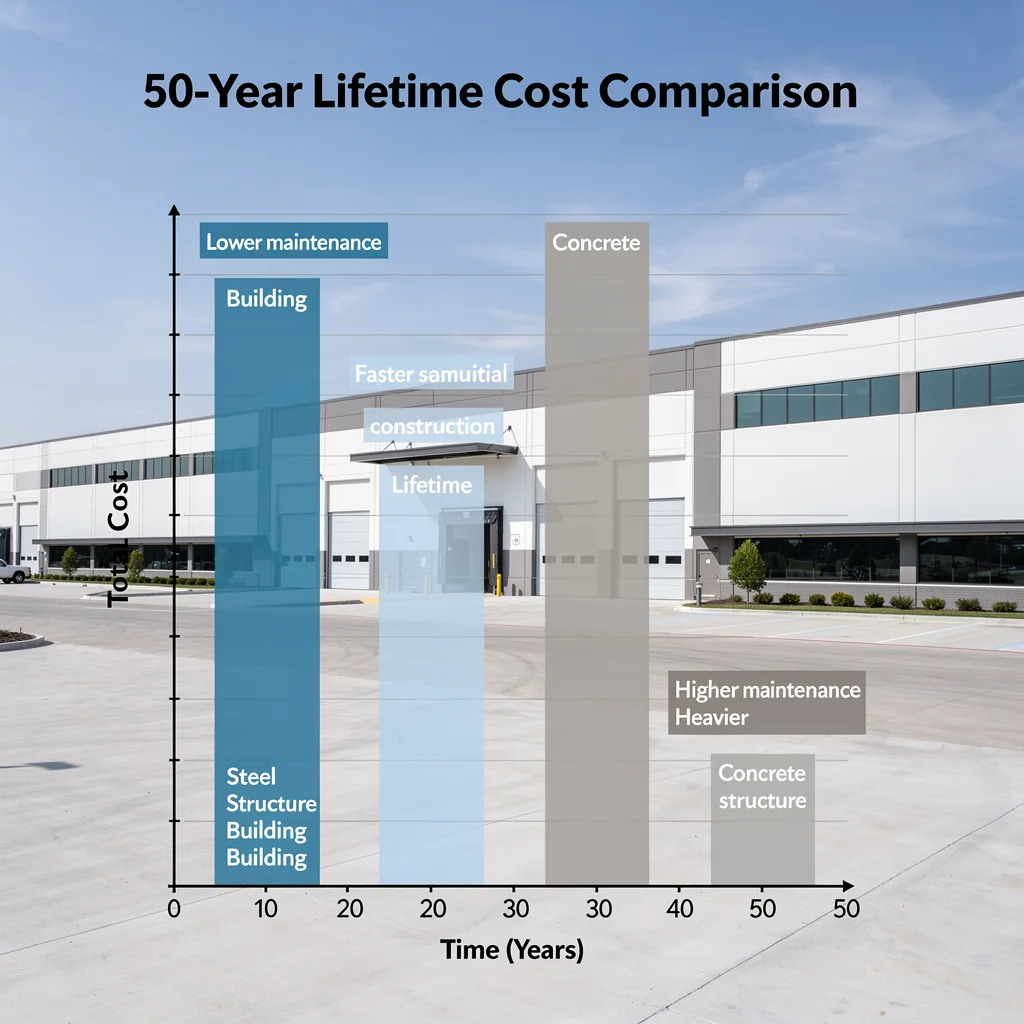
6. Total Cost of Ownership: The 30-Year View
Combining initial cost, maintenance, and operational advantages:
| Cost Category | Steel Structure | Concrete Structure |
|---|---|---|
| Initial construction | $160,000 | $320,000 |
| 30-year maintenance | $35,000 | $65,000 |
| Expansion cost (one bay addition) | $40,000 | $95,000 |
| Opportunity cost (faster occupancy) | $0 | $40,000 |
| End-of-life value (scrap) | +$15,000 | -$20,000 (demolition) |
| Total 30-year cost | $220,000 | $540,000 |
When to Choose Steel
Steel structures outperform concrete in these scenarios:
- Large clear spans (20m+): Steel portal frames achieve spans that would require massive, expensive concrete beams
- Poor soil conditions: Steel buildings are 30–50% lighter, requiring less expensive foundations
- Future expansion needs: Steel frames can be extended by bolting on additional bays
- Seismic zones: Steel's ductility and energy absorption outperforms brittle concrete in earthquakes
- Remote locations: Fewer truckloads (steel arrives as a compact kit) means lower transport costs
- Time-sensitive projects: Steel is operational 2–3× faster — critical for peak season warehouses and production facilities
- Factory-direct quality: CE/ISO certified prefabrication with consistent quality control
When Concrete Still Makes Sense
Steel isn't always the answer. Consider concrete when:
- Basement levels are required — concrete's mass and waterproofing are hard to beat below grade
- Multi-story buildings (5+ floors) — concrete slabs provide better acoustic separation
- Extreme fire ratings — some codes require 3–4 hour ratings that are cheaper with concrete
- Very small spans (<10m) with simple layouts — the prefabrication advantage shrinks
- Locations with local concrete expertise — if skilled steel erectors aren't available nearby
- Tight material-only budget — raw concrete materials can be cheaper if labor is inexpensive
Why Source Your Steel Structure from China
China's steel structure industry offers a combination that's hard to match:
- Factory-direct pricing — 30–50% below Western fabrication costs
- Certified quality — CE (EN 1090), ISO 9001, AWS-qualified welding
- Massive capacity — 5,000+ tons/month from a single factory
- Complete packages — engineering drawings, fabrication, surface treatment, packing, and shipping documentation all from one supplier
Conclusion
The steel structure vs concrete cost equation has never been more favorable for steel. With prefabricated steel building prices at competitive levels, construction timelines 2–3× faster, and modern coatings that deliver 50+ year service life, steel is the rational choice for industrial and commercial buildings in 2026.
The numbers are clear: steel saves 40–50% on initial cost and nearly 60% over the building's lifetime. When you add the flexibility to expand or relocate, the decision becomes even easier.
Ready to start your steel structure project?
Contact Laotie Steel Structure for a free quote within 24 hours. Send us your building dimensions, local wind/snow loads, and any special requirements — our engineering team will prepare a detailed proposal.
📱 WhatsApp: +86 166-5073-5555 🌐 Website: https://www.laotie-steel.com
*Laotie Steel Structure — CE & ISO 9001 certified. 5,000 tons/month capacity. Factory-direct pricing. Ships to 30+ countries.*
Related Articles
Steel Warehouse Quotation: 10 Questions to Ask
10 questions every buyer must ask before ordering a steel warehouse. Compare quotes apple-to-apple: steel grade, tonnage, surface treatment, inclusions
Why Choose a Chinese Steel Structure Manufacturer
Discover why global buyers are turning to Chinese steel structure factories for their construction projects — from competitive pricing to CE/ISO certified
Need a Steel Structure?
Get a free quote from our engineering team. We respond within 2 hours.
Request a QuoteStay Updated
Get steel structure tips, cost guides, and industry insights delivered to your inbox.
No spam. Unsubscribe anytime.