Steel Structure Installation Process and Timeline (2026)
Learn steel structure installation process: preparation, lifting, connection, cladding, and inspection. Complete timeline and best practices.
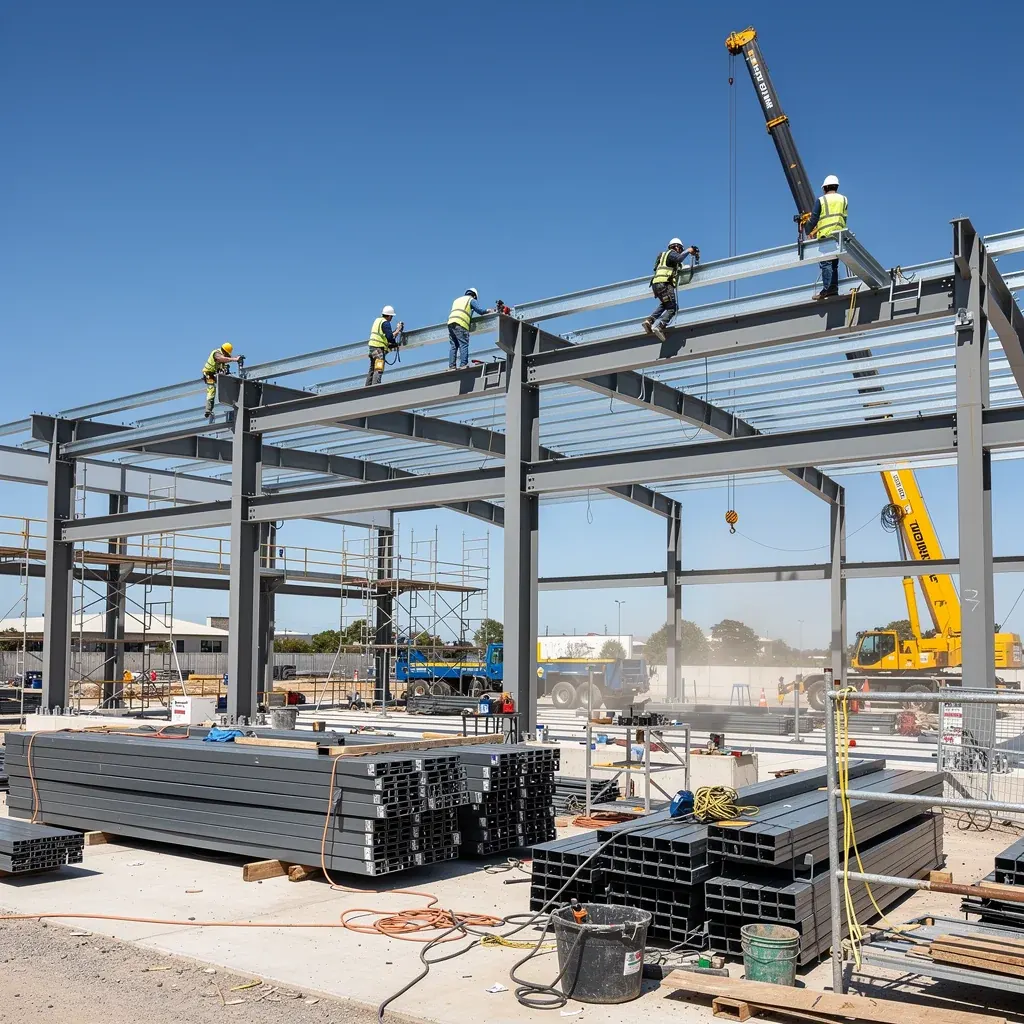
Steel structure installation (erection) is where your building comes to life. This guide covers the entire process — from site preparation to final inspection.
Installation Timeline Overview
| Building Size | Preparation | Erection | Cladding | Total Time |
|---|---|---|---|---|
| 1,000m² | 2 days | 5 days | 7 days | 14 days |
| 2,000m² | 3 days | 10 days | 10 days | 23 days |
| 5,000m² | 5 days | 20 days | 15 days | 40 days |
Step 1: Site Preparation (Days 1-3)
Check Site Conditions
- ✅ Foundation completed and cured (28-day strength)
- ✅ Anchor bolts set correctly (±2mm tolerance)
- ✅ Site leveled and compacted
- ✅ Crane access cleared (6m minimum width)
- ✅ Component storage area prepared
Equipment Required
- Mobile crane (25-50T capacity)
- Forklift (5T)
- Hand tools (wrenches, hammers, levels)
- Safety equipment (harnesses, helmets)
Safety Briefing
- Review erection drawing with team
- Assign roles (crane operator, riggers, bolt tighteniers)
- Check weather forecast (no lifting in high wind)
- Emergency procedures
Step 2: Column Erection (Days 4-6)
Lifting Sequence
- First column (corner column preferred)
- Adjacent column
- Connect rafter between first two columns
- Repeat for all columns
Installation Steps
- Lift column with crane (use proper slings)
- Position on foundation (align with anchor bolts)
- Plumb column (use spirit level or laser)
- Temporarily brace (use steel tubes or cables)
- Tighten anchor bolts (finger tight, final torque later)
- Repeat for all columns
Quality Check
- Column plumb: ±H/500 (2mm per meter height)
- Column spacing: ±5mm
- Base plate level: ±2mm
Step 3: Rafter Installation (Days 7-9)
Lifting Sequence
- First rafter (between two plumbed columns)
- Second rafter (create stable frame)
- Install bracing between frames
- Repeat for all rafters
Installation Steps
- Lift rafter (may require 2 cranes for long rafters)
- Connect to column (bolt connection)
- Plumb and level (adjust with crane)
- Tighten connection bolts (50% torque)
- Install temporary bracing (stabilize frame)
- Repeat for all rafters
Quality Check
- Rafter level: ±L/500
- Connection gap: <2mm
- Frame square: diagonal check (±5mm)
Step 4: Bracing Installation (Days 10-11)
Types of Bracing
- Wind bracing (X-bracing in walls)
- Roof bracing (diagonal rods or tubes)
- Column bracing (stability during erection)
Installation Steps
- Install wall wind bracing (start from corners)
- Install roof bracing (maintain diaphragm action)
- Tension rod bracing (use torque wrench)
- Check all bracing connections
Quality Check
- Bracing tension: as per design
- No loose members
- All connections tight
Step 5: Purlin and Girt Installation (Days 12-14)
Purlin Installation (Roof)
- Start from eave, work to ridge
- Space per drawing (typically 1.2-1.5m)
- Connect with self-tapping screws
- Check alignment (straight and level)
Girt Installation (Walls)
- Start from bottom, work up
- Space per drawing (typically 1.5-2.0m)
- Connect with self-tapping screws
- Check alignment and plumb
Quality Check
- Purlin/girt spacing: ±10mm
- Screw tightness: manual check (no power tools)
- Alignment: visual check from distance
Step 6: Final Bolt Tightening (Day 15)
Bolt Tightening Sequence
- Column base plates (foundation anchor bolts)
- Column-to-rafter connections
- Bracing connections
- Purlin/girt connections
Torque Values
| Bolt Size | Torque (N·m) |
|---|---|
| M12 | 80-100 |
| M16 | 160-200 |
| M20 | 310-390 |
| M24 | 540-680 |
Step 7: Roof Cladding (Days 16-20)
Installation Steps
- Lay insulation (if required) — thermal blanket or rigid board
- Install roof sheets — start from eave, overlap per manufacturer
- Install ridge capping — seal with neutral-cure silicone
- Install flashings — around vents, skylights, equipment penetrations
- Seal all laps — use butyl tape or silicone
Quality Check
- Sheet alignment: ±5mm
- Overlap: as per manufacturer (typically 200mm)
- No water leakage (hose test)
- Flashing seals intact
Step 8: Wall Cladding (Days 21-25)
Installation Steps
- Install wall sheets — start from bottom, overlap upward
- Install corner flashings — outside corners
- Install window/door trim — seal with silicone
- Clean sheets — remove protective film, clean stains
Quality Check
- Sheet alignment: ±5mm
- Fastener pattern: as per drawing
- No dents or damage
- Flashing seals intact
Step 9: Accessories Installation (Days 26-28)
Install
- ✅ Roller shutter doors (electric or manual)
- ✅ Personnel doors
- ✅ Windows
- ✅ Ventilation fans
- ✅ Skylights
- ✅ Gutter and downpipe
Functional Test
- ✅ All doors open/close smoothly
- ✅ Windows lock properly
- ✅ Fans operate correctly
- ✅ Gutter flows water (test with hose)
Step 10: Final Inspection (Day 29)
Structural Inspection
- ✅ All bolts torqued (random check 5%)
- ✅ Column plumb and beam level
- ✅ No visible damage or deformation
- ✅ Dimensions match drawings
Cladding Inspection
- ✅ All sheets secured
- ✅ All flashings sealed
- ✅ No water leakage
- ✅ Appearance acceptable
Documentation
- ✅ As-built drawings
- ✅ Material certificates
- ✅ Bolt torque records
- ✅ Photo documentation
Common Installation Problems
1. Foundation Settlement
Cause: Poor soil, inadequate foundation design Fix: Underpin foundation, re-plumb columns2. Bolt Hole Misalignment
Cause: Foundation error or fabrication error Fix: Slot holes (max 2mm), ream holes, use washer plates3. Column Out-of-Plumb
Cause: Uneven foundation, improper bracing Fix: Adjust with jack, re-tighten bracing4. Roof Leakage
Cause: Improper sheet overlap, failed sealant Fix: Re-seal laps, replace failed sealant5. Crane Accidents
Cause: Overloading, poor rigging, high wind Prevention: Proper lift plan, certified operator, weather monitoringSafety During Installation
Personal Protective Equipment (PPE)
- ✅ Safety helmet
- ✅ Safety harness (when working at height)
- ✅ Safety boots
- ✅ High-visibility vest
- ✅ Gloves
Crane Safety
- ✅ Certified operator only
- ✅ No lifting in high wind (>6级风)
- ✅ Proper slings and shackles
- ✅ Clear communication (hand signals or radio)
Fall Protection
- ✅ Safety harness anchored to structure
- ✅ Safety nets (for high work)
- ✅ Scaffolding (for edge work)
Cost of Installation
| Region | Installation Cost (% of steel cost) |
|---|---|
| China | 15-20% |
| Southeast Asia | 25-35% |
| Australia | 35-50% |
| Africa | 40-60% |
| Europe/North America | 50-70% |
Hire Professional Erection Contractor
Erecting steel structure is dangerous and requires experience. Professional contractors provide:
✅ Safety: Trained crew, proper equipment, insurance ✅ Quality: Correct lifting sequence, proper bolt tightening ✅ Speed: Experienced crew works faster ✅ Accountability: Warranty on workmanship
Laotie Steel Structure can recommend erection contractors in your region:
- 📱 WhatsApp: +86 166-5073-5555
- 🌐 Website: laotie-steel.com/contact
FAQ: Steel Structure Installation
Q: Can I erect the steel structure myself? A: Possible for small buildings (<500m²), but professional erection recommended for safety and quality.
Q: How many workers needed for erection? A: 6-10 workers for 2,000m² building (including crane operator, riggers, bolt tighteniers).
Q: What crane size needed? A: 25-50T mobile crane for standard warehouse. Larger cranes for long rafters or heavy sections.
Q: How to handle bad weather during erection? A: Stop work in high wind or rain. Secure partially erected structure with additional bracing.
Conclusion
Steel structure installation takes 2-6 weeks depending on building size. Proper planning, experienced crew, and good weather are keys to success.
For safe and efficient erection, hire professional contractors. Laotie Steel Structure can support you with:
- ✅ Detailed erection drawings
- ✅ Video installation guidance
- ✅ Erection contractor recommendations
- 📱 WhatsApp: +86 166-5073-5555
- 🌐 Website: https://www.laotie-steel.com
Related Articles
Steel Structure for Cold Storage Warehouse: Design, Insulation & Cost Guide
Complete guide to steel structure cold storage warehouses. Learn about insulated panel systems, vapor barriers, floor design, refrigeration integration, and
How to Build a Steel Warehouse: Step-by-Step Guide (2026)
Learn how to build a steel warehouse step by step: planning, design, fabrication, shipping, foundation, erection. Complete timeline and checklist.
Need a Steel Structure?
Get a free quote from our engineering team. We respond within 2 hours.
Request a QuoteStay Updated
Get steel structure tips, cost guides, and industry insights delivered to your inbox.
No spam. Unsubscribe anytime.