Chinese Steel Fabrication: How Factories Deliver Global Quality
Discover how Chinese steel fabrication delivers CE/ISO certified quality. Learn about CNC cutting, welding, surface treatment and global export standards.
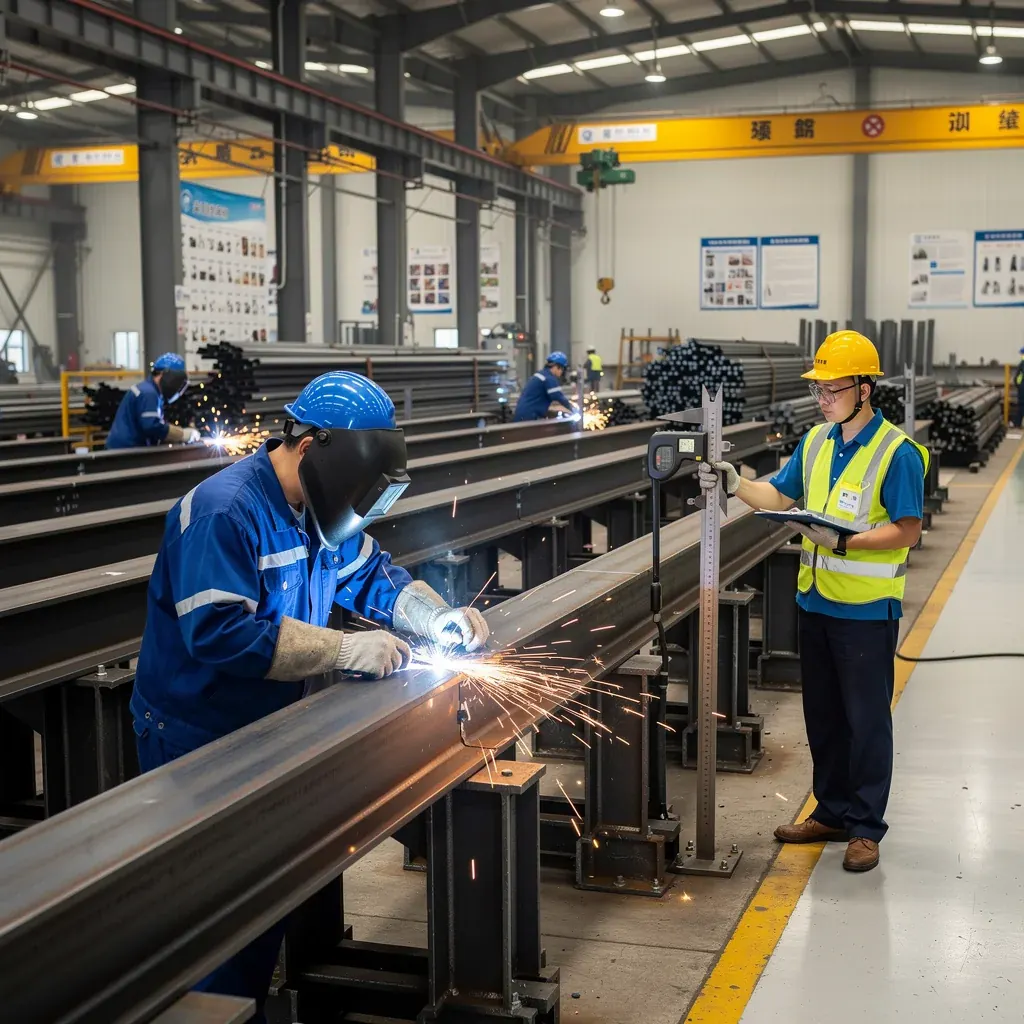
China has produced more than half of the world's steel for more than a decade. What began as a domestic supply industry has matured into a global export ecosystem serving construction projects across Asia, Africa, the Middle East, Australia, and the Americas. For international buyers, the question is no longer whether Chinese steel fabrication is capable, but how to identify the steel structure manufacturer China partners that consistently deliver international-quality work.
At OldTie Steel Structure, our factory in Shangqiu, Henan, ships prefabricated steel buildings to buyers in more than 30 countries. This article explains how modern Chinese steel structure supplier factories combine scale, automation, and certified quality control to compete on the global stage.
Why Buyers Choose Chinese Steel Fabrication
The global shift toward Chinese steel structure sourcing is driven by several practical advantages:
- Integrated raw material supply — Major steel mills, surface treatment shops, and fastener producers are clustered within a few hundred kilometers, shortening lead times and reducing material costs.
- Large production capacity — Established factories commonly run 5,000+ tons per month across multiple production lines.
- Competitive prefabricated steel building price — Factory-direct pricing is typically 30–50% lower than equivalent fabrication in North America, Europe, or Australia.
- Export experience — Leading suppliers understand container loading, documentation, and the inspection requirements of international buyers.
- International certifications — CE marking, ISO 9001, EN 1090, and AWS-qualified welding procedures are now standard at reputable factories.
The Chinese Steel Fabrication Process
Modern steel fabrication China follows a tightly controlled workflow. Each step has a direct impact on installation speed and long-term durability.
1. Material Procurement and Verification
Every order begins with certified steel plate and sections. For structural work, the most common grades are Q235B and Q355B, which are equivalent in performance to S235 and S355 in European standards. Suppliers should provide a mill test report (MTR) for every heat batch, verifying:
- Chemical composition (C, Si, Mn, P, S)
- Yield strength and tensile strength
- Impact resistance at specified temperatures
- Mill origin and traceability
2. CNC Cutting and Profiling
Precision cutting is the foundation of fit-up quality. Factories typically use:
- CNC plasma cutting for plates up to 50 mm, with tolerances around ±0.5 mm
- CNC flame cutting for thick base plates and heavy brackets
- Laser or fiber cutting for connection plates with tight bolt patterns
- Band saws for section steel and tubes
3. Assembly and Welding
Cut plates are assembled into H-sections, box columns, or built-up beams. Automated welding methods include:
- Submerged arc welding (SAW) for H-beam longitudinal seams
- CO₂ gas shielded welding (GMAW) for connections and stiffeners
- Flux-cored arc welding (FCAW) for thicker plates and all-position work
4. Straightening and Dimensional Correction
Heat from welding introduces distortion. Hydraulic straightening machines correct camber, twist, and flange tilt so that every member meets the tolerance of L/1000 or better.
5. Surface Treatment and Coating
Corrosion protection is the single largest determinant of a steel building's service life. Standard processes include:
- Shot blasting to SA 2.5 near-white metal finish per ISO 8501
- Epoxy zinc-rich primer for chemical and salt resistance
- Intermediate epoxy coat and polyurethane topcoat for UV protection
- Hot-dip galvanizing for coastal or high-humidity environments, with zinc layers from 85 to 200 μm per ISO 1461
6. Drilling, Marking, and Packing
CNC drilling produces bolt holes to H12 tolerance. Every component is marked with a unique piece number matching the erection drawings, then bundled for container loading. Export packing usually includes steel strapping, wooden separators, and waterproof wrapping to prevent rust during ocean transit.
Quality Control: What Separates Top Factories from Low-Cost Suppliers
Not every Chinese fabricator operates at the same level. When evaluating a Chinese steel structure supplier, look for these quality signals:
- EN 1090-2 EXC2 execution class certification for structural steel
- ISO 9001:2015 quality management system
- Traceable mill certificates for every heat of steel used
- NDT testing plan with documented UT/MT coverage rates
- Factory pre-assembly for complex structures to verify fit before shipping
- Inspection checkpoints at material, cutting, welding, surface treatment, and final packing
How Steel Structure Processing Affects Total Project Cost
Cutting, welding, and surface treatment each represent a share of the final prefabricated steel building price. Small improvements in processing quality create large savings downstream:
| Processing Quality | On-Site Impact | Cost Risk |
|---|---|---|
| Poor cutting accuracy | Rework, slotting holes, delays | +10–20% installation cost |
| Incomplete welding | Structural weakness, liability | High |
| Inadequate surface prep | Premature corrosion, recoating | +3–5× maintenance cost over 20 years |
| Skipped pre-assembly | Fit-up issues discovered on site | +5–15% erection time |
Common Questions from International Buyers
Can I visit the factory before ordering? Yes. Reputable suppliers welcome visits. OldTie Steel Structure offers live video factory tours via WhatsApp for buyers who cannot travel to Shangqiu.
How long does fabrication take? Typical production time ranges from 20 to 60 days depending on order size, complexity, and current factory schedule.
What steel grades are available? Q235B and Q355B are standard. Higher grades such as Q420, ASTM A992, and S355JR are available for specialized projects.
Do Chinese steel structures meet local building codes? Professional exporters design to international standards (Eurocode 3, AS/NZS 1170, AISC, BS 5950) and adapt calculations to your local wind, snow, and seismic loads. Always have a local engineer review shop drawings before production begins.
Image Suggestions
- CNC plasma cutting machine slicing through a thick steel plate in a factory bay, with sparks visible and a worker inspecting the cut edge.
- Welding station showing an automatic submerged arc welding machine joining H-beam flanges and web plates.
- Shot blasting chamber with steel components moving through abrasive shot streams, demonstrating surface preparation before painting.
Conclusion
Chinese steel fabrication has evolved from a low-cost alternative into a high-capability global supply chain. The key to success is selecting a steel structure manufacturer China partner with transparent quality control, international certifications, and export experience. When processing is done correctly, buyers receive structures that install faster, last longer, and cost less than locally fabricated alternatives.
Contact OldTie for a free quote → WhatsApp: +86 166-5073-5555
*OldTie Steel Structure — CE/ISO certified steel buildings, exported from Shangqiu, Henan, China to 30+ countries.*
Related Articles
CE & ISO Certified Steel Structures: What They Mean
Understand steel structure certifications — CE marking, ISO 9001, IAF, and Supplier Assessment — and why they matter for your construction project.
Steel Structure Floor Deck: Types, Load Capacity & Cost Guide 2026
Complete guide to steel structure floor deck types. Learn about open deck, closed deck, composite floor deck load capacity, span tables, and cost per square
Need a Steel Structure?
Get a free quote from our engineering team. We respond within 2 hours.
Request a QuoteStay Updated
Get steel structure tips, cost guides, and industry insights delivered to your inbox.
No spam. Unsubscribe anytime.