EU CBAM for Steel Imports 2026: A Buyer's Compliance Guide
CBAM is live in 2026. EU importers of steel now pay for embedded carbon, including CN 7308 structures. The 50-tonne threshold, certificate price and supplier data you need.
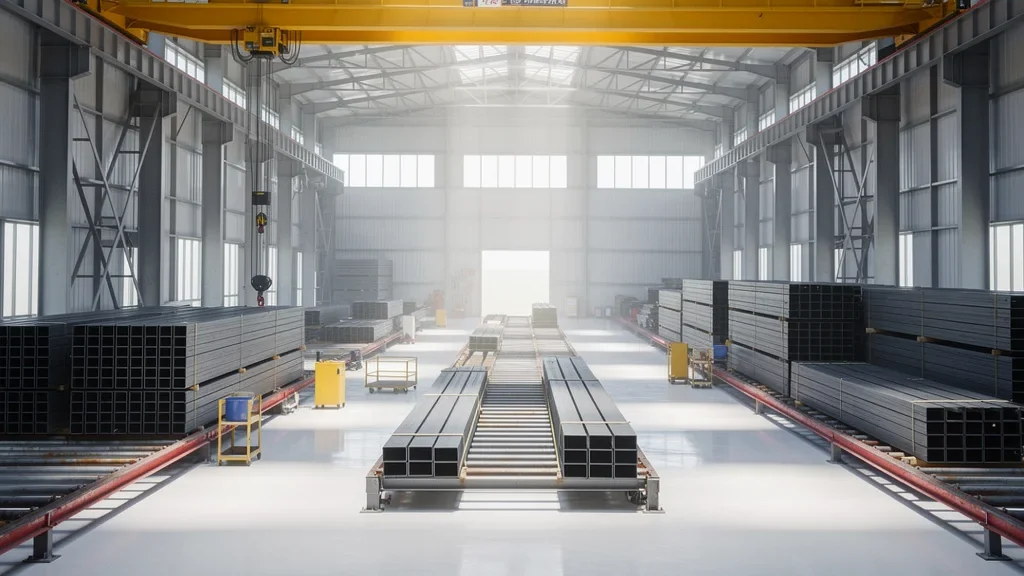
Importing steel into the European Union changed on 1 January 2026. The Carbon Border Adjustment Mechanism (CBAM) is now in its definitive period, and for the first time the carbon emitted when your steel was produced carries a price at the EU border.
This guide is written for the people who actually have to deal with it — procurement managers, finance teams and compliance officers at EU importers, distributors and EPC contractors. It answers five practical questions: does CBAM cover what you import, are you above the threshold, what do you pay and when, where do the emissions numbers come from, and what exactly do you need from your supplier.
It is plain-English guidance, not legal or tax advice. Every figure below comes from Regulation (EU) 2023/956 as amended by the 2025 simplification package, and from official European Commission publications.
Quick Answer: Does CBAM Apply to Steel Structures?
| Question | Short answer |
|---|---|
| Are steel structures covered? | Yes. CN heading 7308, "structures and parts of structures of iron or steel", is in Annex I. Fasteners under 7318 are covered too. |
| Is there a small-importer exemption? | Yes — 50 tonnes. Total net mass per importer per calendar year, aggregated across all covered CN codes. |
| Do you pay anything in 2026? | Not in 2026. Certificates go on sale from 1 February 2027, and the first declaration is due 30 September 2027 for 2026 imports. |
| What is the carbon price? | One certificate per tonne of CO₂e. The published Q1 2026 reference price was €75.36 per tonne. |
| What do you need from your supplier? | Installation-level actual embedded emissions. Verified data is cheaper than the Commission's default values. |
| Are prefabricated buildings covered? | No. Heading 9406 is explicitly excluded from the 7308 scope. |
What Actually Changed on 1 January 2026
The transitional period ran from October 2023 to December 2025 and was reporting only — you filed quarterly emissions data and paid nothing. The definitive period adds four obligations on top of that:
- Authorisation. Only an *authorised CBAM declarant* may import covered goods above the threshold. You apply through the CBAM Registry's Authorisation Management Module, you need an EORI number, and the national competent authority can take up to 120 days to decide. Applications were due before importing and at the latest by 31 March 2026.
- Certificates. Embedded emissions are now covered by CBAM certificates — one certificate per tonne of CO₂e — which you buy and surrender.
- Verification. Actual emissions values must be checked by an accredited verifier. Default values remain the fallback when you have no verified data.
- A real price. The certificate price tracks the EU Emissions Trading System (ETS) auction price, averaged quarterly in 2026 and weekly from 2027.
The 50-Tonne Threshold: Most Importers Are Already Exempt
The single biggest change to come out of the 2025 simplification is a mass-based de minimis. If your cumulative annual net mass of iron and steel, aluminium, cement and fertiliser imports is 50 tonnes or less, you are exempt from authorisation, reporting and surrender.
Three details that catch people out:
- It is per importer, per year — not per shipment. Many small consignments from several suppliers all count toward the same 50 tonnes.
- It aggregates across CN codes. Steel, aluminium and cement all add into one total.
- Electricity and hydrogen are never exempt, at any volume.
Which Steel Products Are Covered — and Which Are Not
Annex I mixes whole chapters with specific headings, so the safe approach is to confirm your exact 8-digit CN code rather than assume. The pattern for iron and steel is:
| CN heading | What it covers | In scope |
|---|---|---|
| 72 | Iron and steel (ingots, semi-finished, flat-rolled, bars, rods, wire) | Yes |
| 7301 – 7311 | Sheet piling, rail material, tubes and pipes, tanks and containers | Yes |
| 7307 | Tube or pipe fittings | Yes |
| 7308 | Structures and parts of structures — portal frames, columns, roof frameworks, lattice masts, balustrades | Yes |
| 7318 | Screws, bolts, nuts, washers, rivets | Yes |
| 7325 / 7326 | Selected other cast and steel articles | Confirm the exact code |
| 9406 | Prefabricated buildings | No — excluded from 7308 |
One more detail worth knowing: for iron and steel, CBAM covers direct emissions only. Unlike cement and fertilisers, indirect emissions from purchased electricity are not counted. That is material to your exposure, and it is why the production route (and the energy a fabricator actually burns on site) drives the number.
What You Pay, and When: the CBAM Factor Ramp
You do not pay on 100% of embedded emissions straight away. The charge is scaled by the CBAM factor, which mirrors the phase-out of free ETS allowances for EU producers. It rises from 2.5% in 2026 to 100% by 2034:
| Year | CBAM factor | Charge per tonne of steel | On a 500 t package |
|---|---|---|---|
| 2026 | 2.5% | €3.39 | €1,696 |
| 2027 | 5% | €6.78 | €3,391 |
| 2028 | 10% | €13.56 | €6,782 |
| 2029 | 22.5% | €30.52 | €15,260 |
| 2030 | 48.5% | €65.79 | €32,895 |
| 2031 | 61% | €82.75 | €41,373 |
| 2032 | 73.5% | €99.70 | €49,851 |
| 2033 | 86% | €116.66 | €58,329 |
| 2034 | 100% | €135.65 | €67,824 |
The formula in one line:
> CBAM cost ≈ embedded emissions × CBAM factor × certificate price − carbon price already paid in the country of origin
Three things follow from that table. First, 2026 is genuinely cheap — a 500-tonne structure carries about €1,700 of carbon cost, noise against the steel price. Second, the steepest single jump is 2029 to 2030, when the factor more than doubles from 22.5% to 48.5% in one year. Third, by 2034 the same building carries roughly €136 of carbon cost per tonne of steel. If you are signing a build-to-suit or a long lease-back, that belongs in the model now, not in 2033.
Where the Emissions Numbers Come From: Default vs Verified
You have two ways to value embedded emissions, and the cheaper one requires work from your supplier.
Commission default values are published per CN code and per production route. They exist so you can file without supplier data — but they carry a conservative mark-up, around 10% in 2026 and rising toward 30% by 2028. You pay more, permanently, for not knowing.
Actual verified values come from the producing installation: measured energy and process emissions for the specific heat of steel that went into your goods, checked by an accredited verifier. This is normally cheaper than the default, and the gap widens as the mark-up grows.
When the goods are a "complex good" — and fabricated structures are, because they are made from precursor steel — the embedded emissions also include the emissions of the precursors. In practice that means your fabricator needs data not only for its own cutting, drilling and welding, but for the steel it bought in. A supplier who cannot trace their input steel back to a mill cannot give you a usable number.
If your supplier's country already charged a carbon price on those goods, that amount can be deducted — with evidence. Keep the paperwork.
What to Ask Your Steel Supplier For
Send this list with your enquiry. A supplier who can answer it is set up for CBAM; one who cannot will cost you money later.
- The exact CN code you will declare, per line item — including whether any part falls under 9406 rather than 7308.
- The production route for the input steel: basic oxygen furnace, electric arc furnace, or a mix — and the share of each.
- Direct embedded emissions per tonne for the specific installation, in tCO₂e/t, with the system boundary stated.
- Precursor emissions where the fabricator buys semi-finished steel rather than making it.
- A monitoring methodology description that an accredited verifier can work from.
- Mill certificates and material traceability tying the shipped steel back to the declared emissions.
- Any carbon price already paid in the country of production, with documentary evidence for the deduction claim.
Who This Does Not Apply To
CBAM is narrow, and it is worth being explicit about the boundaries rather than assuming the worst:
- Below 50 tonnes a year of covered goods, per importer, aggregated across suppliers — exempt.
- Prefabricated buildings under 9406 — outside the 7308 scope today.
- Goods that stay outside the EU — CBAM is a border measure. Shipping to the UK, Norway or a non-EU transhipment port does not trigger it, though the Commission has signalled a scope review for later in the decade.
- Second-hand or reclaimed steel — the position depends on the CN code and the route; confirm case by case rather than assuming.
Beyond the EU: Why Carbon Data Matters Anyway
CBAM is the most developed version of a pattern that is spreading. Buyers in Australia, the UK and parts of Asia are asking for embodied carbon data for their own reporting, and large corporates increasingly need it for Scope 3 inventories regardless of where the steel is shipped.
The practical conclusion is the same in every case: the ability to state the embedded emissions of a steel package, with traceability back to the mill, is becoming a normal part of a supplier's technical file — like mill certificates and coating thickness reports before it. Suppliers who can produce it on request will keep winning work from buyers who have to report.
Frequently Asked Questions
Do I pay CBAM in 2026?
No. For 2026 imports you buy certificates from 1 February 2027 and surrender them by 30 September 2027, alongside your first annual declaration. From 2027 you must also hold certificates covering at least 50% of your accrued emissions at the end of each quarter.
Is my steel structure import below the 50-tonne threshold?
Possibly. The test is your own cumulative annual net mass across all covered CN codes and all suppliers, not the size of any single consignment. A single 500-tonne warehouse is well above it; a fabricator taking a few tonnes of profiles a year may not be.
What is the CBAM certificate price?
One certificate covers one tonne of CO₂e. The price tracks the EU ETS auction price — averaged quarterly in 2026 and weekly from 2027. The first published figure, for Q1 2026, was €75.36 per tonne.
Can my Chinese supplier give me the emissions data I need?
Yes, but only if they can trace their input steel to the mill, state the production route, and report direct emissions for the specific installation. We supply this data pack on request for structural steel orders, together with mill certificates and coating reports — see the certificates page or send us the specification and we will confirm what your CBAM file needs.
Does CBAM apply to prefabricated buildings (CN 9406)?
Heading 9406, prefabricated buildings, is excluded from the 7308 structures scope as the regulation currently stands. If your order mixes prefabricated units with fabricated structural steel, separate the line items and confirm the CN code for each.
What happens if I import without an authorisation?
Above the threshold, goods cannot be released for free circulation without a valid CBAM account number or application reference number. Non-compliance exposes you to delays and penalties, and the national competent authority enforces through the CBAM Registry. This is why the 50-tonne calculation is worth doing properly and early.
Conclusion
CBAM is not a cliff edge in 2026 — the real cost arrives between 2029 and 2034, when the factor climbs from a quarter to full weight. What matters this year is the groundwork: confirm your exact CN codes, work out whether you are above 50 tonnes across all suppliers, get your authorisation in order, and start collecting actual emissions data instead of defaulting.
The supplier question is the one you can act on immediately. Ask for installation-level embedded emissions, the production route and mill-level traceability — and treat an answer that cannot produce them as a cost you will carry for the next eight years.
If you are specifying structural steel for an EU project and need the emissions and traceability documents alongside the usual mill certificates, send us the drawings and destination port and we will come back with both the commercial and the compliance picture. You can also see indicative unit rates in our 2026 price guide or run a first-pass tonnage through the steel cost calculator.
Related Articles
Top 10 Steel Structure Manufacturers in China (2026 Prices)
Compare the top 10 steel structure manufacturers in China for 2026: capacity, certifications, export reach, FOB prices, and how to choose the right one.
Steel Warehouse Quotation: 10 Questions to Ask
10 questions every buyer must ask before ordering a steel warehouse. Compare quotes apple-to-apple: steel grade, tonnage, surface treatment, inclusions
Need a Steel Structure?
Get a free quote from our engineering team. We respond within 2 hours.
Request a QuoteStay Updated
Get steel structure tips, cost guides, and industry insights delivered to your inbox.
No spam. Unsubscribe anytime.