How to Choose a Steel Structure Manufacturer: 10-Point Checklist
Evaluate Chinese steel structure manufacturers with this 10-point checklist. Certification, production capacity, quality control, export experience and
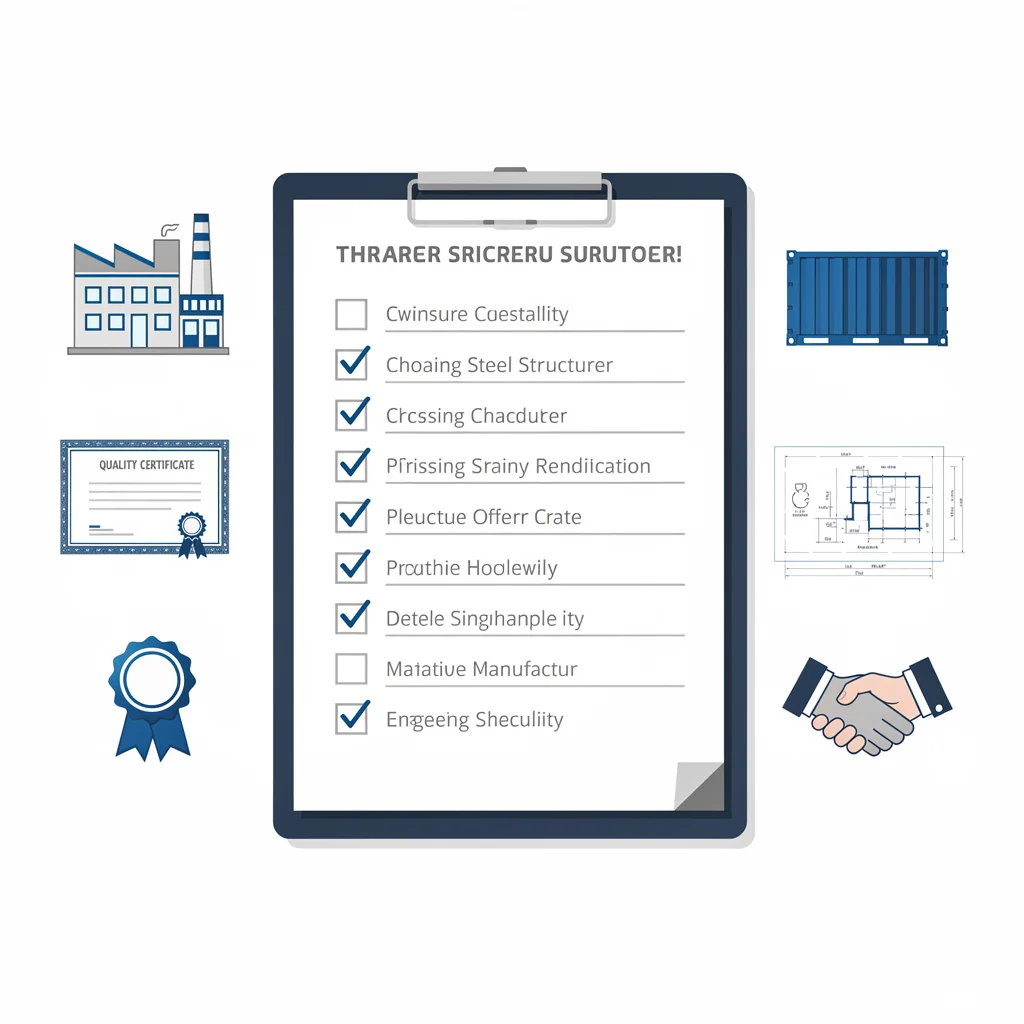
The Chinese steel structure industry exports over 10 million tons annually to 200+ countries. With thousands of manufacturers to choose from, the challenge isn't finding a supplier — it's finding the right supplier.
A bad choice means late deliveries, poor fit-up on site, excessive corrosion within months, or structural failures that put lives at risk. A good choice means factory-direct pricing without sacrificing quality.
This 10-point checklist gives international buyers a systematic framework for evaluating steel structure manufacturers. Use it before you send an inquiry, during supplier evaluation, and when reviewing proposals.
The Checklist at a Glance
| # | Check Point | Why It Matters | Red Flag |
|---|---|---|---|
| 1 | Third-Party Certifications | Proves quality systems | "We're certified" without naming the certifier |
| 2 | Production Capacity | Can they deliver on time? | No info on monthly tonnage |
| 3 | Export Experience | Proven international logistics | "First export project" |
| 4 | Engineering Team | Design capability | No in-house engineers |
| 5 | Quality Control Process | Consistent output | No QC documentation |
| 6 | Reference Projects | Real-world proof | No verifiable client references |
| 7 | Payment Terms | Risk allocation | Demands 100% upfront |
| 8 | Delivery Track Record | On-time performance | No shipping history |
| 9 | After-Sales Support | Long-term partnership | No response within 24 hours |
| 10 | Pricing Transparency | Fair and predictable | Hidden fees in small print |
1. Third-Party Certifications
Legitimate manufacturers hold certifications from recognized international bodies. These are not optional — they are the minimum entry requirement.
Must-have certifications:
- ISO 9001:2015 — Quality management system (verify on IAF CertSearch)
- CE Marking — For European projects (check the notified body number)
- SGS / Bureau Veritas / TUV — Third-party inspection reports
- ISO 14001 — Environmental management
- ISO 45001 — Occupational health and safety
- AWS Certified Welder — For projects requiring AWS standards
- AS/NZS 5131 — For Australian projects
2. Production Capacity
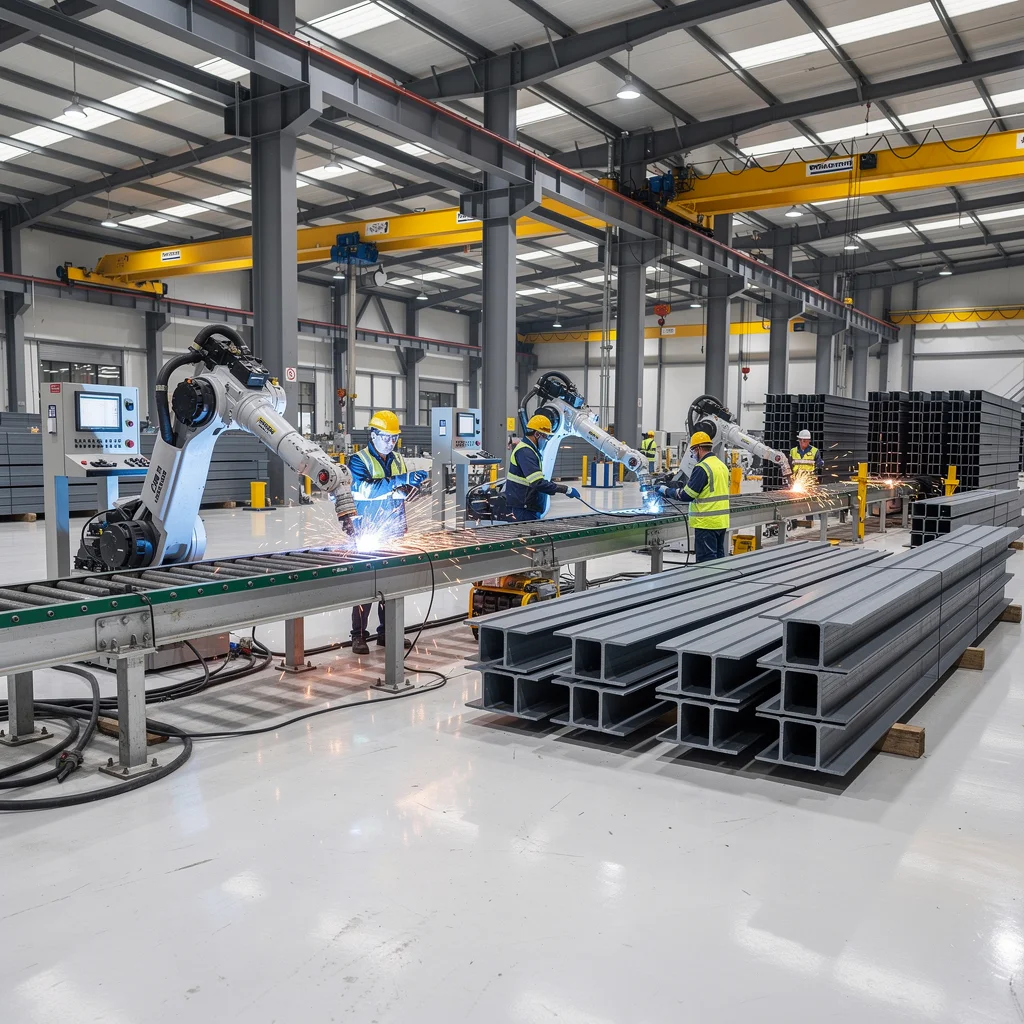
A manufacturer's monthly tonnage determines whether they can handle your project without delaying existing orders.
What to ask:
- Monthly production capacity (tons/month)
- Number of production lines
- Maximum single-piece weight and dimensions
- Current capacity utilization (if over 90%, delivery may slip)
3. Export Experience
Exporting steel structures involves complex logistics: container loading, break-bulk shipping, customs clearance, and documentation. Not all domestic Chinese manufacturers have this experience.
Key indicators of export capability:
- Number of countries exported to
- Familiarity with FOB, CIF, and DDP terms
- Experience with your country's import regulations
- Relationships with freight forwarders for your region
4. Engineering Team
The engineering team is the backbone of a steel structure manufacturer. Without in-house engineers, the manufacturer is essentially a fabrication shop that cannot optimize designs or solve problems.
What to evaluate:
- Number of structural engineers
- Software used (Tekla Structures, AutoCAD, PKPM)
- Experience with international codes (AISC, Eurocode 3, GB)
- Ability to produce erection drawings and shop drawings
5. Quality Control Process
Quality control in steel structure manufacturing happens at multiple stages. A serious manufacturer documents each stage.
QC stages to verify:
- Raw material inspection: Mill certificates checked against order requirements
- Cutting and drilling: Dimensional checks after CNC processing
- Welding: Visual inspection + NDT (ultrasonic, magnetic particle, or dye penetrant)
- Surface treatment: Paint thickness, adhesion, and salt spray testing
- Final assembly: Trial fitting before shipment
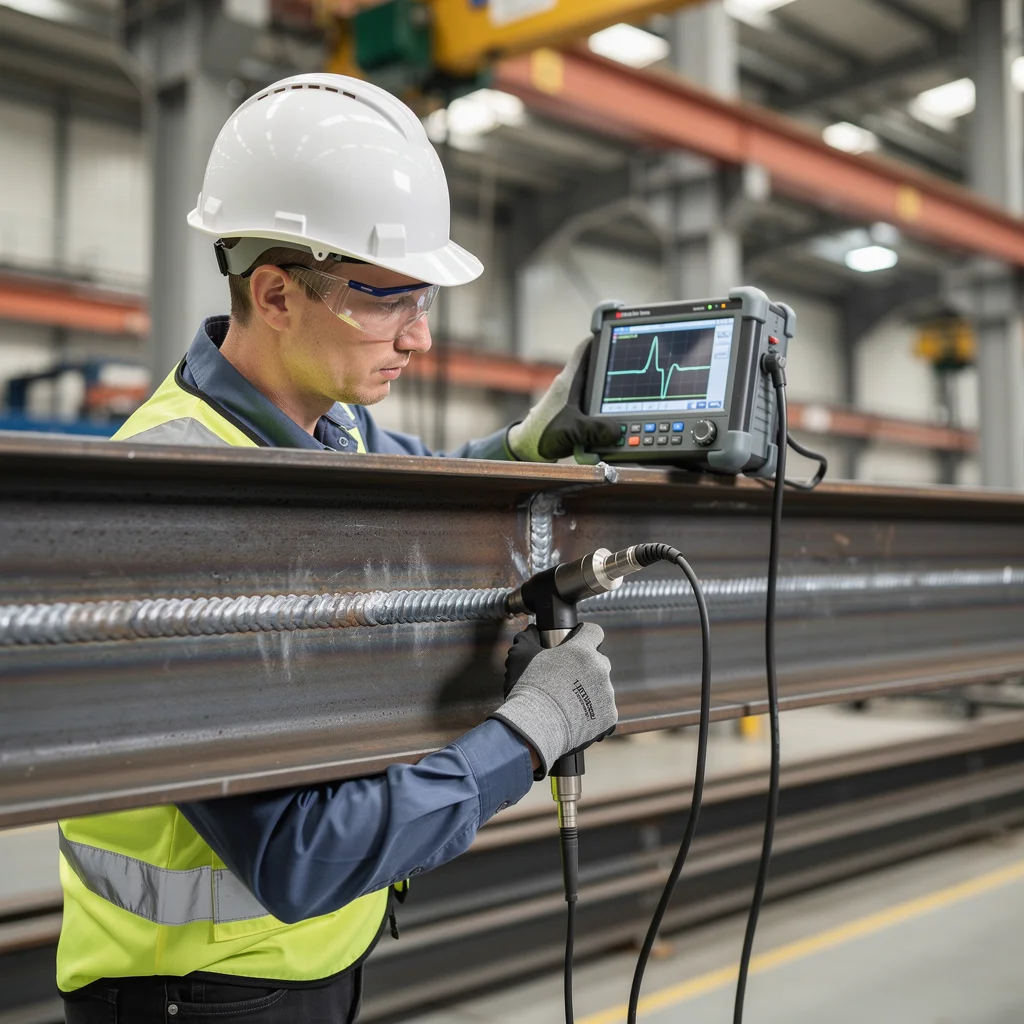
from a recent project to see the level of documentation.
6. Reference Projects
Real projects with verifiable details are the strongest proof of capability. Be wary of manufacturers who only show CGI renderings as "project photos."
What to look for:
- Projects similar to yours (warehouse, factory, sports hall, etc.)
- Projects in your region or climate zone
- Client testimonials with company names and contact details
- Photos from multiple stages (fabrication, loading, installation)
7. Payment Terms
Payment terms reflect trust and risk distribution. Standard industry terms for international steel structure projects:
| Stage | Typical Payment | Notes |
|---|---|---|
| Deposit | 30% | Upon contract signing |
| Progress payment | 40% | Upon material preparation or fabrication start |
| Balance before shipment | 30% | Upon completion, before loading |
- Demanding 100% payment upfront
- Refusing Letter of Credit (LC) for large projects
- Vague payment schedule with no milestones
8. Delivery Track Record
Late delivery of steel structures can delay an entire construction project, causing significant financial losses.
Ask for:
- Average lead time from deposit to shipment
- Percentage of on-time deliveries (target 95%+)
- Shipping documentation for recent projects
- Container vs break-bulk experience
9. After-Sales Support
Steel structure projects almost always require some post-shipment support: missing bolts, damaged parts, erection questions, or additional engineering changes.
What good support looks like:
- English-speaking project manager assigned to your account
- Response within 24 hours (email or WhatsApp)
- Ability to send a technician to site if needed
- Spare parts available for quick shipment
10. Pricing Transparency
A transparent quotation makes it easy to compare suppliers. Hidden fees erode trust and inflate budgets.
What a transparent quote includes:
- Steel quantity (tons) with a clear rate per ton
- Surface treatment (grit blast, primer, top coat)
- Loading and securing charges
- Documentation fees (mill certificates, inspection reports)
- Exclusions (foundation, erection, cladding if specified separately)
Putting It All Together: A Scoring Template
Use this simple scoring system to compare manufacturers objectively:
| Criteria | Weight | Supplier A | Supplier B | Supplier C |
|---|---|---|---|---|
| Certifications | 15% | |||
| Production capacity | 15% | |||
| Export experience | 15% | |||
| Engineering team | 10% | |||
| Quality control | 10% | |||
| Reference projects | 10% | |||
| Payment terms | 5% | |||
| Delivery track record | 10% | |||
| After-sales support | 5% | |||
| Pricing transparency | 5% | |||
| Total | 100% |
Frequently Asked Questions
Q: How many suppliers should I evaluate? A: 3-5 is ideal. More than 5 becomes difficult to manage; fewer than 3 lacks competitive comparison.
Q: Should I visit the factory before placing an order? A: For projects over $100,000, a factory visit is strongly recommended. If travel is not possible, request a video inspection call.
Q: What is the minimum order quantity (MOQ) for custom steel structures? A: Most manufacturers have a MOQ of 20-50 tons. Laotie Steel accepts projects from 10 tons.
Q: How can I verify a manufacturer's claims before ordering? A: Check certifications online, request video calls of the production line, ask for real client references, and consider hiring a third-party inspection company.
Conclusion
Choosing a steel structure manufacturer is a business decision that affects project cost, timeline, and safety. By systematically evaluating each supplier against these 10 criteria, you minimize risk and maximize the chance of a successful partnership.
Ready to evaluate your options? Contact Laotie Steel for a detailed quotation and we'll walk you through each of these 10 points. Our team is experienced working with international buyers from 30+ countries.
*Laotie Steel Structure Co., Ltd. — CE & ISO 9001 certified. 5,000 tons/month capacity. 15 years of export experience to 30+ countries.*
Related Articles
Steel Warehouse Quotation: 10 Questions to Ask
10 questions every buyer must ask before ordering a steel warehouse. Compare quotes apple-to-apple: steel grade, tonnage, surface treatment, inclusions
Why Choose a Chinese Steel Structure Manufacturer
Discover why global buyers are turning to Chinese steel structure factories for their construction projects — from competitive pricing to CE/ISO certified
Need a Steel Structure?
Get a free quote from our engineering team. We respond within 2 hours.
Request a QuoteStay Updated
Get steel structure tips, cost guides, and industry insights delivered to your inbox.
No spam. Unsubscribe anytime.